
This article closes our series on the future of the region. While agility and evolution were discussed in previous instalments, the real challenge will be preserving what has made Bündner Herrschaft so special: a balancing act between modernity and established practices. Looking ahead, it is essential to discuss a generation of winemakers who are relatively new. Not necessarily inexperienced, but bringing fresh perspectives and techniques that enrich the existing wine scene without unsettling it.
Silas Hörler
Hörler’s path to winemaking was anything but conventional. Rather than following a classical winemaking education, he first trained as a cook, which shows when you taste his wines: they are beautifully crafted and exceptional at the table. Together with his wife Martina, Silas tends selected parcels in Fläsch and Maienfeld, producing small quantities with an uncompromising focus on quality. Spontaneous fermentation, natural yeasts, no technical intervention. Pinot Noir and Chardonnay sit at the heart of the range, though Sauvignon Blanc and Pinot Blanc also feature.
I was particularly impressed by the single-vineyard Chardonnay Valäris, aged entirely in new oak. While oak is often criticised by modern drinkers, contemporary coopers frequently produce barrels with very light toasting, limiting the development of vanilla aromas. Valäris is a textbook example of how to master oak ageing while keeping oak flavours in check. The wines are rare, sought after, and already considered among the most exciting to emerge from the appellation in recent years. Certainly an estate to watch.
Unfortunately the winery doesn’t have a website but you can find the wines at Gerstl.
Weingut Hermann
Weingut Hermann in Fläsch is not new. The Hermann family has been making wine for several generations. Nonetheless, it deserves a place here because Roman, who recently took over the management of the estate, has added a fresh patina without obscuring the estate’s identity. His pursuit of a particularly pure expression of the region is already evident in the wines.
Roman belongs to a generation of winemakers who travelled abroad to broaden their horizons and deepen their understanding of viticulture and winemaking. After gaining experience in New Zealand, the United States, South Africa, and Germany, he returned to Fläsch. Today, he cultivates six hectares on the Fläscher Halde, including the historic terraced vineyard at Fläscher Bad, a steep, stony site steeped in history.
The finest wines are released under the Grand Maître label. I love the fruit-forward Pinot Noir Grand Maître, but I would urge readers to seek out the Completer Grand Maître, which may well be one of the finest wines in the entire appellation. It offers a beautiful finish and a level of complexity that makes you want to keep the bottle for yourself.
Weingut Hermann
Hinterdorf 6
7306 Fläsch
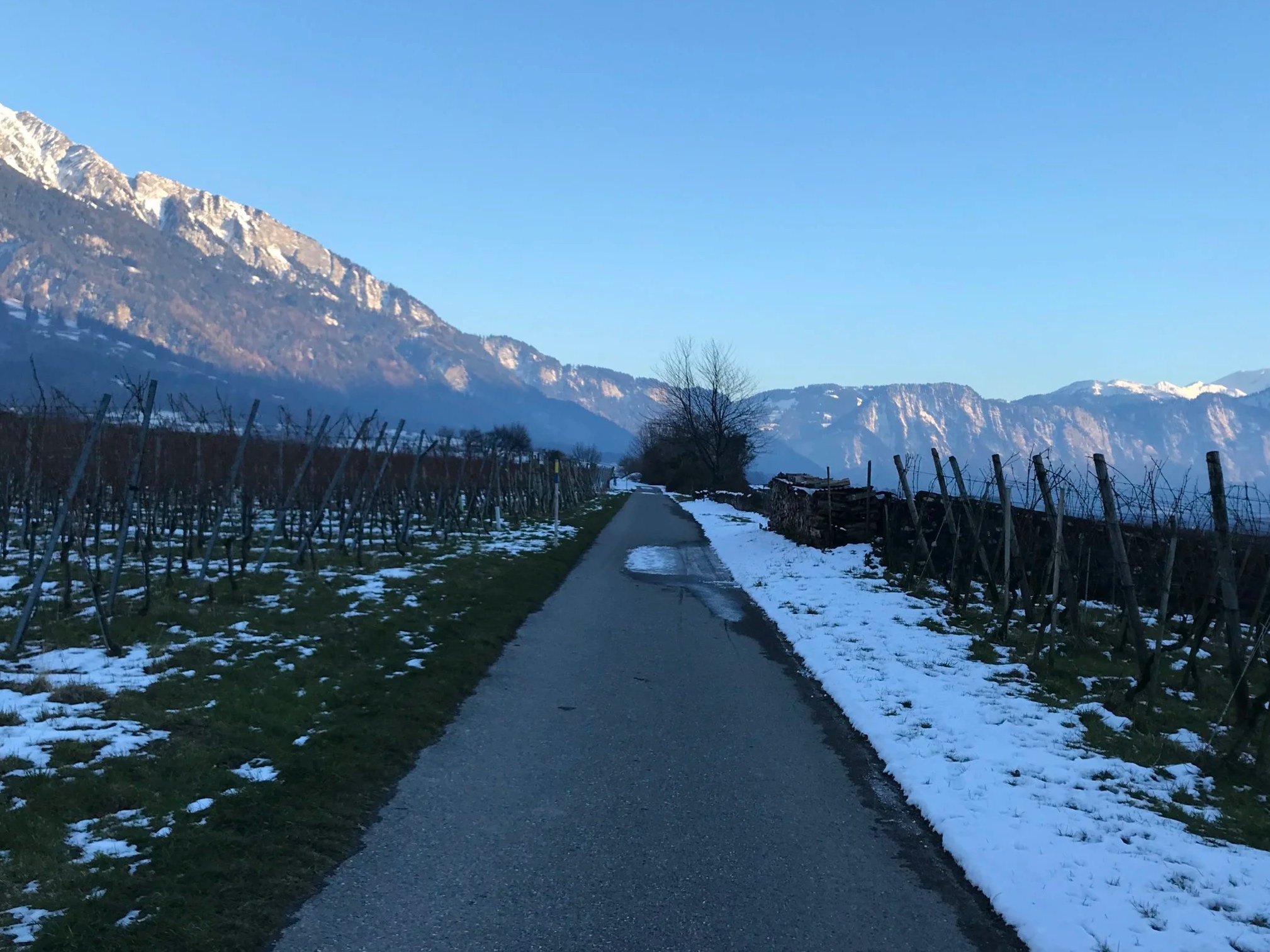
Fläsch, Switzerland, 2017.
Pinot Noir still accounts for roughly 70% of Bündner Herrschaft’s 420 hectares, but white varieties and sparkling wines are steadily gaining ground. At the same time, consumers are drinking slightly more white wine, and the long-term rise of sparkling wine has encouraged producers to diversify. Chardonnay, Sauvignon Blanc and Pinot Blanc are increasingly visible in the vineyards, while more estates are embracing traditional-method sparkling wines. In many ways, the region’s evolution mirrors that of the market itself.
To close this series, it is worth underlining that Bündner Herrschaft is adapting its wine production to meet modern tastes. Traditional-method sparkling wines are increasingly prevalent, as are white wines more broadly. Perhaps this is the region’s greatest strength: moving with the market rather than remaining anchored to the past, while preserving the patina that makes it so distinctive. Where else could one find such harmony?
Read all the articles from this series, here:
Bündner Herrschaft: A Well-Kept Secret