
This is the first article in a series focusing on Bündner Herrschaft. In this article, we will look at its viticultural history and its rise to fame in the early 1990s. Later articles will examine wineries across three categories — what I consider the holy trinity — winemakers who consistently represent the very best of the region year after year. We will then focus on the stars, something briefly discussed in the cult wines articles, before finally discussing the newcomers and concluding with some thoughts on why the region has become so successful.
Bündner Herrschaft is often called the Burgundy of Switzerland, a comparison that feels inevitable, although perhaps more flattering to Switzerland than threatening to Burgundy.
The similarities are obvious. Pinot Noir dominates the conversation. Producers increasingly focus on single vineyards and precise parcel work. Discussions around exposition, limestone and clonal selection have become commonplace. There is also the same obsession with scale: tiny villages producing wines that somehow command international attention disproportionate to their size.
But the scale itself is almost absurd. Burgundy stretches across roughly 30,000 hectares of vineyards. Bündner Herrschaft has approximately 420. Entire villages in Burgundy are larger than that. Switzerland itself has around 15,000 hectares under vine, meaning Bündner Herrschaft accounts for only around 3 percent of the country’s vineyard area.
The history of viticulture here predates modern Switzerland itself. The Romans cultivated vines in eastern Switzerland, but one of the key references appears in 1321, when the grape Completer was first documented in Malans. The name derives from completorium, the evening prayer recited by the canons of Chur before they were permitted a final glass of wine. Today, Completer survives almost as an act of cultural stubbornness, occupying barely 10 hectares after coming close to extinction during the twentieth century.
Historically, Bündner Herrschaft looked very different from the Pinot Noir stronghold it is today. White varieties once dominated the region. Completer, Elbling and later Müller-Thurgau played significant roles, largely because growers prioritised reliability and quantity. Viticulture here was agricultural before it became cultural. Farmers cultivated vines alongside livestock and mixed crops, producing wine primarily for local consumption.
The transformation toward Pinot Noir happened gradually from the seventeenth century onward, though the real consolidation around Pinot Noir accelerated during the twentieth century as Switzerland began pursuing a more quality-focused wine culture. Today, Pinot Noir accounts for roughly 70 to 75 percent of plantings in Bündner Herrschaft. More than 50 grape varieties still exist across the region, but most now occupy marginal positions.
This shift mirrors broader changes across the wine world. Regions increasingly simplify their identity around one flagship variety capable of carrying international prestige. Napa has Cabernet Sauvignon. Barolo has Nebbiolo. Bündner Herrschaft chose Pinot Noir.
The conditions here are unusually favourable for Pinot Noir. Vineyards sit between 500 and 600 metres above sea level, exposed to the warm föhn winds descending through the Alps. The climate preserves acidity while still allowing full ripening, something that would have seemed improbable in Switzerland generations ago. The result is a style of Pinot Noir that often combines alpine freshness with surprising depth. Personally, the wines often feel friendlier and less austere than their western counterparts.
The reputation of Bündner Herrschaft is relatively recent. For much of the twentieth century, Swiss wine remained largely domestic in both production and ambition. Quantity often mattered more than precision. The late twentieth century changed this. Producers began pursuing lower yields, Burgundian élevage and more serious site expression.
Ironically, just as Bündner Herrschaft fully established itself as a red wine region, white grapes have begun reappearing. While Pinot Noir still dominates plantings, producers have quietly renewed their interest in Chardonnay, Sauvignon Blanc and Completer. Climate change partly explains this reversal. Warmer growing seasons have made alpine viticulture more reliable, but they have also increased the value of freshness and acidity. At the same time, consumer preferences have shifted noticeably across Europe. Heavy, tannic reds no longer occupy the same unquestioned position they once did. Drinkers increasingly favour tension, drinkability and earlier accessibility.
Bündner Herrschaft appears unusually well positioned for this transition. The region’s altitude naturally preserves acidity, even in warmer vintages. White wines here retain a certain alpine sharpness that many warmer European regions are beginning to lose. Completer, in particular, feels symbolic of the region itself: obscure, difficult and quietly resilient.
The irony is that despite growing international attention, most of the wine never leaves Switzerland. Production remains tiny. There are no sprawling négociant houses or massive export programmes. Scarcity here is not manufactured through allocation strategies; it is simply the consequence of geography.
That restraint gives Bündner Herrschaft a certain charm. In an era where every wine region seems eager to become globally recognisable, Bündner Herrschaft still feels oddly secretive. The wines are discussed internationally, but mostly consumed locally. You rarely encounter them casually abroad. They remain slightly hidden, tucked between mountains and protected by a domestic market willing to absorb almost everything produced.
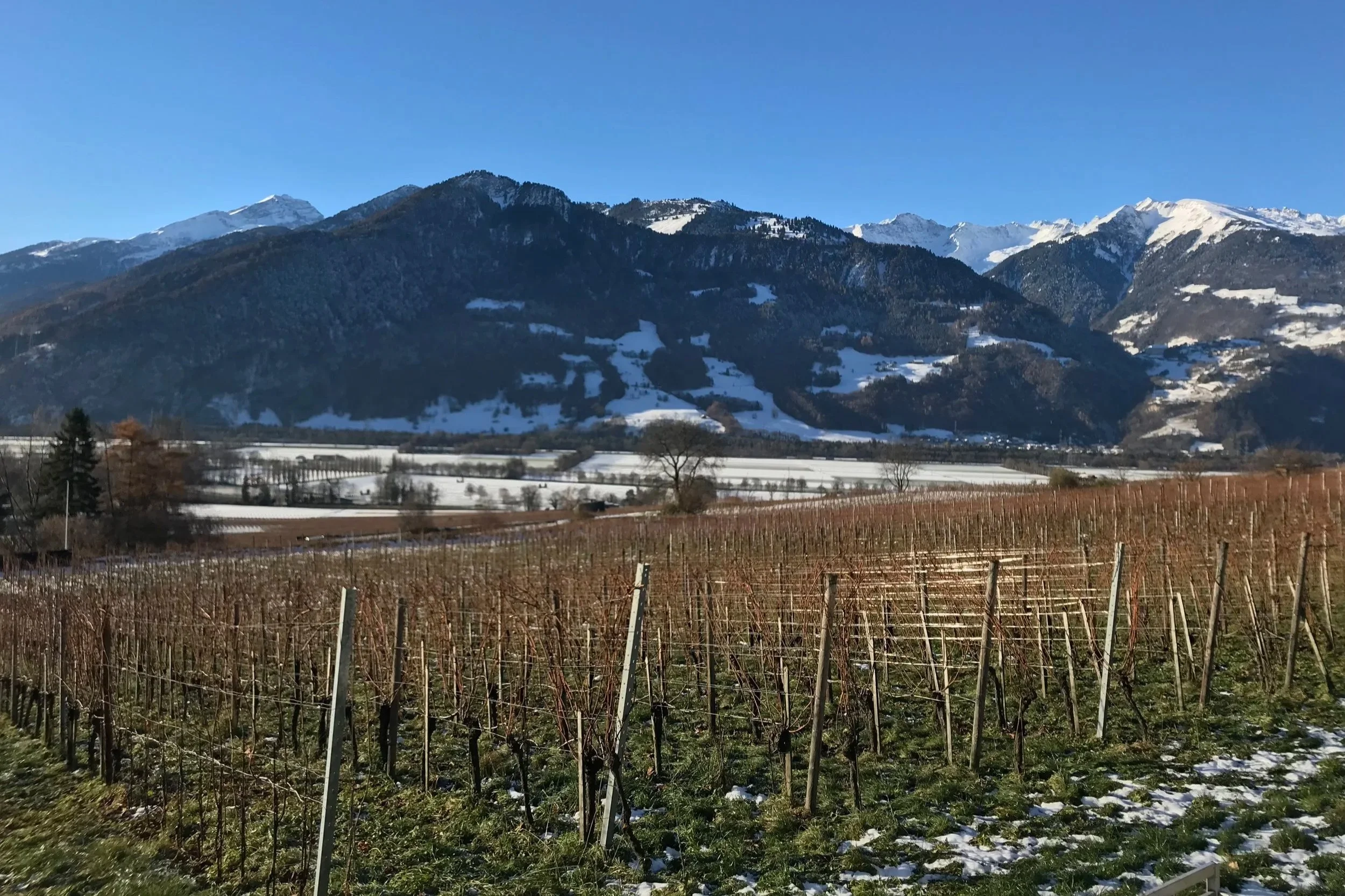
Malans, Switzerland, 2017.
Read all the articles from this series, here:
Bündner Herrschaft: A Well-Kept Secret