
Meet the experts: José from Drunken Grapes
José is co-owner and co-founder of Drunken Grapes, a Swiss-based Champagne shop that also curates tastings and events in Zürich.
*****
We taste the first wine, served blind to José. It’s a Blanc de Blancs non-dosé from Brda, Slovenia.
Nicolas: I like to welcome my guests with a bit of a blind tasting, a very humbling experience.
José: Bubbles are always tricky. I’d say it’s a white grape. Not Champagne, maybe a crémant from France or northern Spain.
N: Does it feel like méthode traditionnelle to you?
J: Yes, possibly without dosage. Hard to be sure.
N: Interesting—this one’s actually from the Brda Hills in Slovenia. 100% Chardonnay. About 11–12€ a bottle.
J: It doesn’t have the usual buttery Chardonnay taste, but it’s excellent!
N: I guess now is the right time to introduce yourself; how did wine become part of your life?
J: I started in private banking and studied law, so wine wasn’t my profession initially. My Spanish heritage gave me a cultural connection to wine, even if my parents barely drank. Over time, exposure to friends, colleagues, and clients in private banking introduced me to serious wine.
My brother Oscar, now my business partner, has been in spirits for years and founded Zurich’s first gin distillery, Turicum. Four or five years ago, we decided to start Drunken Grapes—a boutique online Champagne shop, focused solely on small independent growers in France.
We work with family-run wineries, often fifth or sixth generation, many now led by younger generations bringing fresh ideas. Our focus is online; for many producers, we are their exclusive Swiss distributor.
N: The wine world is so vast—what drew you specifically to Champagne?
J: My brother’s work in spirits introduced us to it. Champagne became the lighter, celebratory alternative to hard alcohol at professional events and gatherings. A trip to the Champagne region changed everything—we discovered incredible small-grower wines, completely different from the big brands most people know. Each producer has a unique terroir and style.
We considered Spanish sparkling wines like Cava or Corpinnat, closer to our heritage, but logistics and market education were challenges. Champagne has built-in awareness, making positioning easier.
N: That’s the incredible strength of Champagne. The marketing is everywhere, something I detailed in an article I wrote recently about the region.
J: Exactly. The big houses dominate globally, producing millions of bottles and controlling branding and marketing. But small growers play a key role—they produce their own wines and supply grapes to the big brands. It’s a relationship of mutual dependence.
N: The wine industry is shifting in recent years. People drink less, but we also see new consumptions trends—what kind of shifts are you seeing in Champagne right now?
J: Drier Champagnes are increasingly popular, driven by smaller producers experimenting with freshness and precision. They have freedom because a large part of their harvest goes to the big houses, reducing financial risk. Unlike industrial brands, small growers can adapt each vintage and create expressive, terroir-driven wines.
Tastes differ by region. Western Europe favors drier styles; other markets like Asia or parts of the US often prefer slightly sweeter wines. Like coffee, many start sweet but learn to appreciate purity over time.
The trend toward drier, expressive Champagnes is growing among younger producers and urban consumers. Big groups respond by acquiring talent or small producers, but small-grower Champagne is gaining momentum.
The second wine is served, a bottle of Léoville Barton 1998.
N: What’s your take on this one?
J: Difficult. First, Tuscany comes to mind… maybe northern Italy?
N: I’m getting a bit of pepper here—does that resonate?
J: Yes… could be France? Bordeaux or northern Italy, maybe 2010?
N: It’s Saint-Julien, 1998. to me this is a classical Claret from Bordeaux, before the craze of overly ripped wines that came in the early 2000s.
J: Woaw. Still very fresh.
N: I keep seeing rosé Champagne everywhere—how do you feel about it? I have difficulties enjoying rosé in general, even more in Champagne. I always find the wines too heavy and lacking the freshness of the paler counterparts.
J: Personally, I prefer non-rosé. Rosé is fruit-forward, slightly sweeter, traditionally a dessert style. In Switzerland, it’s often drunk as an aperitif, which isn’t ideal.
Production is complex—making rosé requires extra work, sometimes producing red wine first. Lower volumes increase cost. At events, rosé sells best; it’s festive, aspirational, and carries lifestyle associations—spring, summer, holidays, luxury. From a business perspective, it’s essential, even if I prefer classic styles.
N: What does a Champagne specialist drink after work?
J: I try not to overconsume Champagne despite working with it. Red wine is part of my heritage, but I’ve grown to enjoy whites more—especially because my partner prefers them. Champagne is, after all, a white wine with bubbles.
N: To conclude, I tend to believe that the education is key to enjoy a glass of wine properly, not for its mere pleasure but also for the history and work behind it. What would you like people to know before they pop a bottle of Champagne?
J: One thing that surprises me is how often people drink Champagne from the wrong glass. Using a flat or regular cup for such a high-quality, expensive wine—it almost feels disrespectful. The vessel matters because it affects the aromas, the bubbles, and the overall experience.
N: I tend to agree, you’re preaching to the converted; I wrote an article recently on this fundamental question.
J: Another common mistake is serving it too cold. Many people chill Champagne to 7 or 8°C, but a serious, gastronomic Champagne should be closer to 11 or 12°C. That warmer temperature allows you to taste all the flavors fully. Of course, for a terrace or hot weather, it’s fine to chill more, but for serious wines, it makes a big difference.
People also forget that Champagne is essentially an excellent white wine with bubbles. The winemaker starts with a very high-quality still wine and then performs a second fermentation in the bottle, sometimes aging it for months or years. That takes time, care, and risk—they could have sold the base wine easily, but instead they choose to make Champagne.
Because of this, it’s a shame that Champagne is often treated as just an aperitif, a “starter” before the main wines. Many people then switch to ordinary reds or whites, sometimes of lower quality than the Champagne they just enjoyed, simply because it’s sparkling. In reality, Champagne can pair beautifully with many dishes. One of my favorite pairings is sushi with a dry, mineral-driven Blanc de Blancs. The saltiness of the fish and the bubbles complement each other perfectly. There are countless other surprising matches—cheese, roasted chicken, even fried foods. People just don’t always experiment with it.
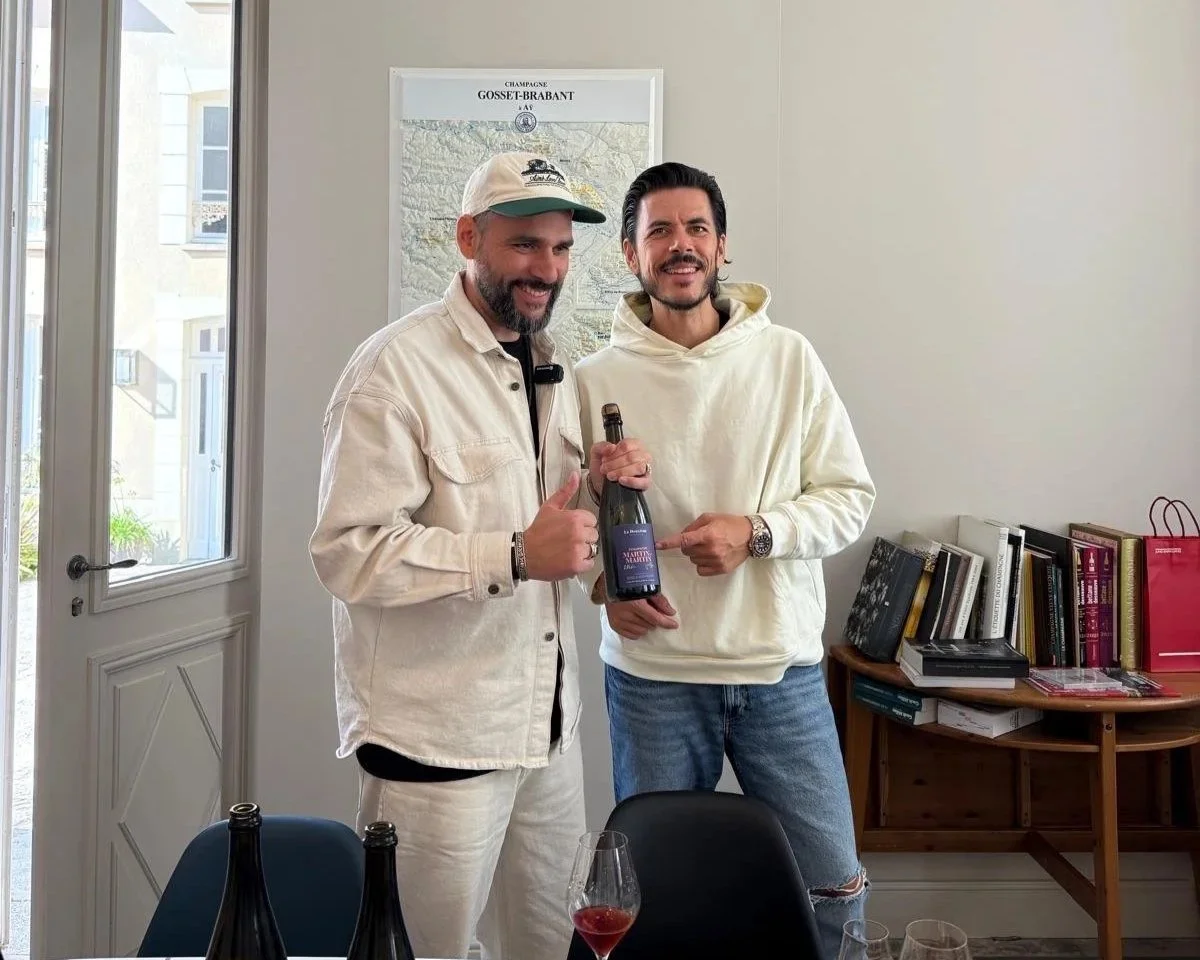
Oscar and José, Aÿ-Champagne, France, 2025.