In recent years, the wine world has welcomed a myriad of new vignerons in Champagne. All of a sudden, your cool-looking neighbourhood restaurant has a wine list full of grower Champagne. Sometimes formal, but very often cool-looking labels. Gone are the times of heavy monochromatic labels with golden writing. Now, you get an off-white label with typefaces in Silian Rail that would make Patrick Bateman sweat.
The wines are also different. It used to be heavy, jammy, often too sweet and, let’s be honest, boring. Today, it is fresh, light, and makes you question whether you really want to share the bottle or have it on your own.
Champagne is first and foremost a marketing coup. Every aspect of Champagne over the centuries was carefully thought out. Champagne screams celebration; it is what you drink to celebrate a birthday or what you cheer with when you get promoted at work. It has a very smart business model that makes a lot of wine regions very envious. It has been a product of exports since early on, and one could argue that it was one of the first European ventures; bottles were made by German winemakers (think Bollinger, Krug, Roederer) in France and sold in the United Kingdom. Collaboration at its best.
The uniqueness of Champagne relies on its business model. Think about all the names you can list from Champagne: most of them aren’t wine growers but Négociant-Manipulants. This means that they don’t necessarily own a vineyard; they simply buy grapes and make the wine. They don’t work the land. This is in the hands of small growers who own 90% of the vineyards. The Négociant-Manipulants establish long-term contracts with growers at a price that may vary over the years. And they usually pay well. So well that it often doesn’t make sense for a small grower to vinify himself; it will never be as profitable.
Because Champagne wines can be made of multiple vintages, the big houses can control the supply. If a year has less demand or an oversupply, they keep the wine for another year. Such huge reserves are also great to smooth out bad vintages. You have a great year, you can promote a great vintage Champagne. You have a lesser year, blend it with other vintages to make a vin non-millésimé. There, a lot lies in the blending, where big houses have an army of tasters who make sure that their flagship non-vintage wine stays the same over the years.
The sheer size of these wineries is also baffling. One might think of Champagne as small cellars and an elegant gentleman corking bottles by hand. This is as realistic as Emily in Paris. Moët et Chandon produces 30 million bottles a year. Veuve Clicquot? 15 million. These are industrial empires, who impose prices on growers, create a stable product over the years, and ship it around the globe. On a recent trip to the region, I was told that a bottle of Veuve Clicquot Brut costs less than 5 euros to make but retails for well above 40 euros. Not bad margins when you produce millions of bottles.
Through well-thought-out marketing strategies, the big houses managed to be present at all mondain events. A slick vernissage at a gallery in Soho? Champagne. Formula 1 podium? Champagne. Fashion weeks all around the globe? Champagne. They even received warrants from royal families around the world. Some of them even managed to befriend rappers and we started to see bottles popping on MTV.
But in the small villages around Reims and Épernay, some growers became unhappy with their situation. Sure, the big houses brought a steady income, fire in the furnaces of their big castles. But deep down, they were lacking the vibrant yet cumbersome life of winemaking. They couldn’t argue about the intrinsic value of their plots; it was all mixed up with their neighbours’ by the big houses. They also had little say in the style of the wine that was produced, and, dare I say, some got properly bored of the pompous wines produced by certain houses. They wanted freshness and novelty. All around the world, wine drinkers were exactly looking for that as well.
Over the course of a decade, families started to sell fewer grapes to the big houses and kept some to make their own wines. A great calculated risk that proved to be costly. Yes, they would keep a steady income (alas, smaller), but part of the production would be kept for their own wines. Investments in a proper wine cellar were needed, as was finding sales channels for new, maybe great, but very unknown wines. Thank God many of them took the risk, and we now have amazing vignerons, or Récoltant-Manipulants. Some wines are reaching stratospheric prices, proving that the risk taken was well worth the effort.
A couple of years ago, I was in Champagne with a friend who has a great Champagne shop in Switzerland. We were looking for new and up-and-coming vignerons. We stumbled upon a small winemaker in Mailly, making great wines. He had just started to make his own wines after selling grapes to the cooperative in the village for many years (they also have that over there). Fresh, explosive, serious—the right flavours at the right time. We were also amazed by the price: 20 euros a bottle. Nearly half of what you pay for industrial entry-level wines. The bargain of the century. Oh, and the label looks great. Of course.
So what to make of all of this? Why should you care? Well, drink more Champagne, of course. If I may suggest one thing: forget the big houses that sell industrial wines and buy wines from small vignerons. Forget the fancy millésimé Champagne that only a few can understand and get a bottle of their entry-level Brut or Extra Brut. Usually a blend of the traditional varieties, sometimes single varietal. It is usually well-made, a good expression of the winery’s philosophy, and you will rarely go wrong. In my experience, if their entry-level wine isn’t good, the rest will just be worse.
A friend of mine once said Champagne is the drink for every day, in the sense that you can drink it at a birthday, a wedding, or a funeral. And to that, I cheer.
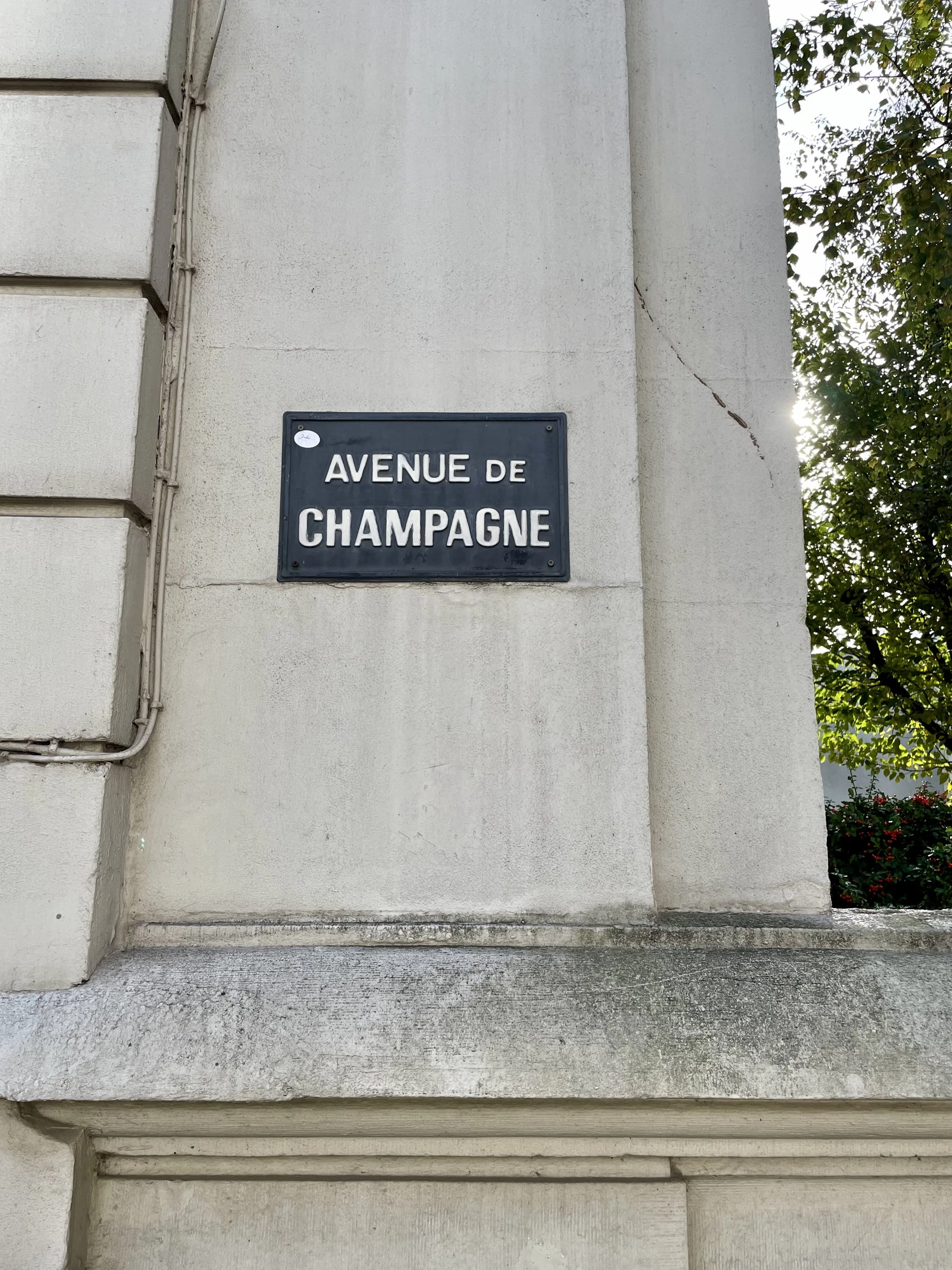
Epernay, France, 2022