Sometimes a wine is so good it deserves more. It is so distinctive, so peculiar that it attracts the crowds of formal tasters. Often divisive, they attract a following of devoted fans without aiming for consensus or perfection, to be fair, such wines are above the small considerations of points and a thumbs up. They are so different that they fly above us, as if the world was not enough.
Of course we need to go to France to find such wines. I am a big proponent of drinking wines from remote regions, pushing the boundaries of what we consider traditional wine-producing countries. Nonetheless, France has a special place in the wine world; it transformed a very agricultural product into a luxury found in every high-end restaurant around the globe. Its grape varieties were exported all over the world, from Malbec in Argentina to Chenin in South Africa and Sauvignon Blanc in New Zealand.
There's something else the French did really well: regulating their wine through the AOC system across the whole of France. The roots of the AOC system reach back further than most people assume, to a wine crisis rather than a wine triumph. The late nineteenth century had already devastated French vineyards with phylloxera, and as supply collapsed, fraud rushed in to fill the gap. Wines from obscure or inferior plots were suddenly being sold under the names of famous regions, and growers in places like Champagne and Burgundy watched their reputations get diluted by producers who had never set foot on their soil. Early laws in 1905, 1919 and 1927 attempted to protect the idea of geographic origin, but lacked any real legal teeth, definitions were vague, and enforcement was patchy at best.
It was Châteauneuf-du-Pape, somewhat fittingly, that provided the prototype. In 1923, Baron Pierre Le Roy de Boiseaumarié, a lawyer and winegrower at Château Fortia, helped local producers draft the first real set of appellation rules: defined boundaries, permitted grape varieties, minimum alcohol levels, and restrictions on yield. It was a radical idea at the time, that a wine's identity could be legally tied not just to where it came from, but to how it was made. That local initiative became the template for a national system a decade later, formalised through the Comité National des Appellations d'Origine (CNAO), established in 1935 to administer this new category of wine.
The first six AOCs were recognised on 15 May 1936: Arbois, Cassis, Cognac, Châteauneuf-du-Pape, Monbazillac, and Tavel, a modest list that would eventually grow into one of the most influential quality systems in the food and beverage world. What began as an emergency response to fraud and economic collapse in the 1930s gradually became something else entirely: a vocabulary for terroir itself, a way of saying that a piece of land could have a personality worth protecting by law.
Unfortunately, sometimes these AOCs are limiting. So much so that two French wineries have their own AOC. Not in the sense that they own a particular plot of land or a climat in Burgundy, the way Domaine de la Romanée-Conti owns every vine of La Tâche. They are, quite literally, the only producer permitted on a specific appellation, an entire AOC reduced to the size of a single estate. It makes them something of a rarity that needs to be cherished.
High above the right bank of the Rhône, just south of Condrieu, a small amphitheatre of terraced vines clings to a granite slope facing due south. This is Château-Grillet, and at roughly 3.5 hectares it is, and has long been claimed to be, the smallest appellation in France. Unlike Condrieu, which surrounds it and shares the same grape, Viognier, Château-Grillet has never been a shared appellation. It has only ever had one name attached to it: the estate itself.
The property's winemaking history stretches back centuries, with records of vines on this exact slope dating to the eighteenth century and beyond, but it was in 1936, in that very first wave of AOC creations following the founding of the CNAO, that Château-Grillet was granted its own appellation. This was a deliberate decision, not an accident of paperwork. The authorities recognised that the site's combination of steep granite terraces, a unique microclimate trapped in its natural amphitheatre, and a long, singular ownership history justified treating the estate not as a parcel within a larger appellation, but as an appellation unto itself. The AOC boundary was drawn to match the property line exactly, and it has stayed that way ever since.
For most of the twentieth century the estate remained in the hands of the Neyret-Gachet family, who guarded its reputation with a certain old-world stubbornness, releasing wines only when they felt ready and rarely chasing trends. In 2011 the property was acquired by François Pinault's Artemis Domaines, the same group behind Château Latour, bringing renewed investment without disturbing the essential fact that has defined Château-Grillet since 1936: one slope, one producer, one appellation.
If Château-Grillet is the old guard of single-estate appellations, Coulée de Serrant is its more contemporary, more contrarian cousin. Located in Savennières, in the Loire Valley, this seven-hectare amphitheatre of schist and volcanic soil has been planted to Chenin Blanc since the year 1130, when Cistercian monks cleared the slope and built the terraces that still define it today. Few vineyards in France can claim an unbroken viticultural lineage of nearly nine centuries.
For most of that history, Coulée de Serrant existed as a celebrated climat within the broader Savennières appellation, exceptional, certainly, but not legally distinct. That changed in 1984, when the vineyard was granted its own AOC, separate from Savennières altogether. The decision recognised what generations of tasters already believed: that the site's terroir, its steep, sun-trapping bowl of schist overlooking the Loire, produced wines distinctive enough, and consistently enough tied to a single piece of land, to warrant a denomination of its own.
The estate had passed through various hands over the centuries, but it was Nicolas Joly, who took over the property in the 1970s, who would come to define its modern identity. Joly became one of the most outspoken evangelists for biodynamic viticulture in the world, converting Coulée de Serrant to biodynamic farming as early as 1980, years before the practice had any real currency in fine wine circles. His insistence that the vineyard be farmed without compromise, treated almost as a living organism in its own right, only reinforced the logic of its separate AOC status: this was never going to be a wine made like its neighbours, so why should it share their name.
Today the estate remains in the Joly family, now overseen by Nicolas's daughter Virginie, and it continues to produce a single, uncompromising dry white wine from a single variety on a single slope, exactly as it has, in one form or another, for nearly nine hundred years.
Trying such wines is really a treat. They are distinctive to their neighbours (Condrieu for Château-Grillet and Savennières for Coulée de Serrant), offering quite unlimited aging potential, a depth and a complexity not often seen for their respective grape variety.
AOCs are a powerful tool of standardisation through minimum requirements while still allowing real freedom in the vineyard and the cellar. For Château-Grillet and Coulée de Serrant, the world is not enough, but it is such a perfect place to start.
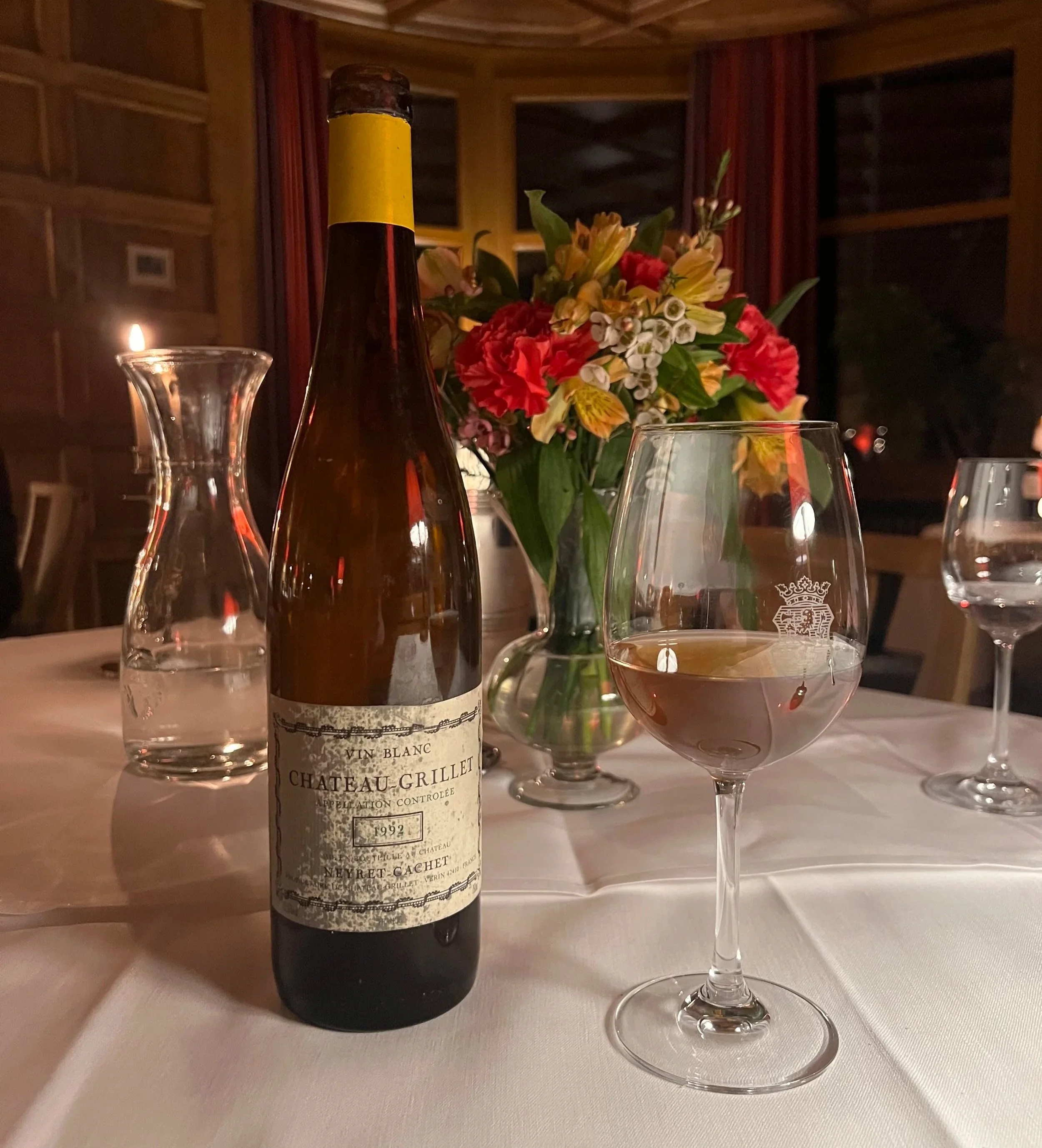
Kleine Scheidegg, Switzerland, 2024.