
Sweet wines are changing. Two centuries ago, they were the craze of restaurants and royal courts around the world: German Rieslings fetched Bordeaux prices, and even Champagne and Barolo were made in sweet styles. Today, dry is king. Acidity may break your teeth, but residual sugar is treated like a witch in Salem. Few regions have embraced this spirit of modernity quite as completely as Tokaj.
As discussed in a previous article, Tokaj was the first region in the world to classify its vineyards, and it has produced some of the finest sweet wines of the last centuries. Its range is wide. Since the 2013 amendment to the product specification, Aszú must contain at least 120 g/L of residual sugar. Szamorodni, which can be dry or sweet, Fordítás, Máslás and the rare Eszencia complete the sweet family.
Over the last 20 years, winemakers have shifted towards dry Furmint, which suits modern tastes. Sugar has become the public enemy, closely followed by alcohol. A sweet wine is now a hard sell. Dry white wines make up some 70% of Tokaj production, and the first modern commercial dry Tokaj wines appeared in the early 1990s from estates such as Disznókő and Hétszőlő.
I understand the winemakers: you have to follow market trends, and dry wine is considerably less labour-intensive and less dependent on the vagaries of botrytis than Aszú. Their success also rests on an approach very similar to Burgundy's, with grand cru-style vineyard classification underscoring the top sites. Tokaj classified its vineyards as early as the 1730s, roughly 120 years before Bordeaux in 1855. Mézes Mály, along with Mád sites such as Szent Tamás and Úrágya, ranked among the top vineyards in that historical classification. István Szepsy has been perhaps the most rigorous in the search for perfect dry wines. He shows soil variation vineyard by vineyard, and he has put dry Tokaj on the tables of the best restaurants.
This has arguably been a commercial success. Tokaj is back on the map, and production rose between 2024 and 2025 while global wine exports declined. But it also puts Tokaj in an arena that is already crowded with great dry white regions such as Burgundy, Südsteiermark, the Rheingau and the Wachau. Consumers now compare bottles, which is something Aszú never really allowed. Even its distant cousin Sauternes comes from another planet: the wines are fundamentally different.
While I love dry Tokaj, I lament that many winemakers are moving away from what made Tokaj famous. There were many styles of sweet Tokaj, and some have become rare, such as Fordítás, made by pouring fresh must over the pomace of aszú berries already used. The puttonyos system, which let consumers read the sweetness of a wine, has faded too. Since 2013, Aszú no longer has to be labelled in puttonyos, and a minimum sugar level has replaced the old scale of 3 to 6.
On a recent trip to Tokaj, I visited Úri Borok in Mád, on top of a small hill. After a brief chat with the owner, my Hungarian being non-existent, we walked through the extensive cellar. The walls in this part of the world are covered in black cellar mould, which keeps the humidity high around the barrels. After the maze, our hosts selected a few bottles and we went upstairs to taste. His first comment was that we would start with a dry wine, but that it held little interest for him. It was there more to prepare our palates. The wine was delicious, with green apple, crushed stones, a beautiful Furmint. Why would he present it as a simple wine?
As soon as we tried the sweet wines, I understood. Aszú, and sweet Tokaj in general, has a very specific complexity, with dried mango and cooked apple. The dry wines cannot match it, and I would argue nothing else in the world can. Simplification is not always an improvement. You cannot simplify Dostoevsky. The Brothers Karamazov needs its three brothers, Smerdyakov and all the contradictions between them. You can read the Wikipedia summary, but it will never be the same as reading nearly a thousand pages.
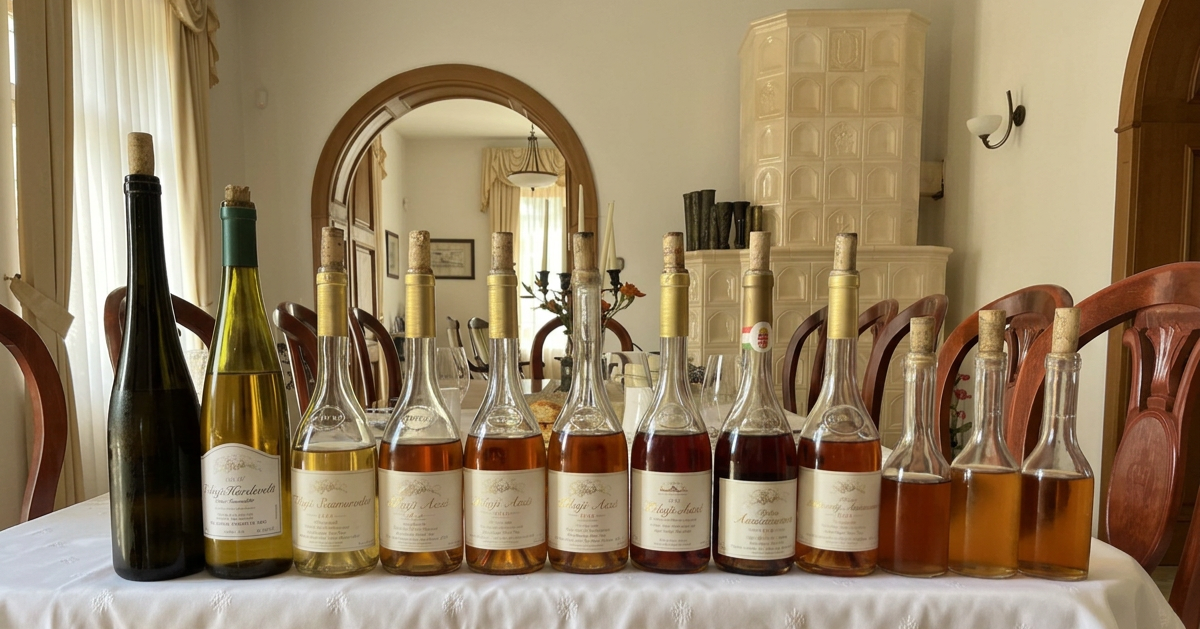
Mád, Hungary, 2023
In a world of oversimplification, where everything must be simple, we should look for complexity and difficulty. Tokaj may benefit from dry wine, standing neck and neck with the best whites. Yet its true beauty lies in the complexity of Aszú, Szamorodni, Fordítás and Eszencia. Like Dostoevsky, it hides its beauty behind hardship and complexity.