The Confrerie du Tastevin
History is often forgotten, and the 1990s already feel like a while ago. Burgundy today looks like an eternal wine region, producing the world's most sought-after bottles vintage after vintage, at prices that seem to only ever go up. This was of course not always the case. A century ago, Burgundy wines were not selling well, and an intervention was needed.
By the early 1930s the region was sitting on wine it could not move. The vintages of 1929, 1933 and 1934 were genuinely strong, in some cases excellent, but the Depression had crushed demand across Europe and the cellars of the Côte d'Or were full to the brim with unsold stock. It wasn't a quality crisis. Growers and négociants had good wine and no buyers, at a moment when the rest of the economy offered little reason for optimism either.
Two Burgundians from Nuits-Saint-Georges decided to do something about it. Georges Faiveley, a winemaker, and Camille Rodier, a wine writer, gathered friends in a cellar and founded the Confrérie des Chevaliers du Tastevin on 16 November 1934. Their reasoning, as it's been retold since, was almost defiant: wine this good is cause for joy, not complaint, so if the cellars are full, empty them, invite the world in, and revive the old Bacchic fraternities to do it properly. Ten years later, in 1944, the founding members bought the Château du Clos de Vougeot itself and made it the Confrérie's seat, a 12th-century building the Cistercians had built alongside the vineyard.
The purpose was never subtle: promote Burgundy's wines and its regional cuisine, keep Burgundian folklore and festivities alive, and pull visitors toward the region. What made it stick was the seriousness with which the ceremony was built, borrowing directly from the Cistercians' own Chapitres Généraux, the assemblies once held to keep the order's scattered houses connected. It worked well enough, and quickly enough, that by the postwar decades the Confrérie was inducting heads of state and film directors alongside growers and négociants, Charles de Gaulle and Alfred Hitchcock among them. A club invented to move surplus stock had, within a generation, become something people crossed oceans to be asked to join.
Why it worked is best explained by sitting through one, and I was lucky enough to be invited to a chapitre this past June. Being deep in the French countryside, I expected perfect service and great food, and I wasn't disappointed. After the new members are inducted, guests move into a large hall, men in black tie, women in beautiful dresses. What stays with you is the choreography: the waiters move as one, serving several hundred people at a perfect, unhurried pace. Oeufs en meurette is apparently a tradition at these dinners, and it arrived exactly when it should have. The wine list sits printed on the table in front of you, and it's not a menu you choose from, it's what the Confrérie has curated for the evening, drawn from the famous villages around the château. There's a ceremonial weight to the whole evening that pulls people in from everywhere, and you leave understanding why this format has survived intact for ninety years.
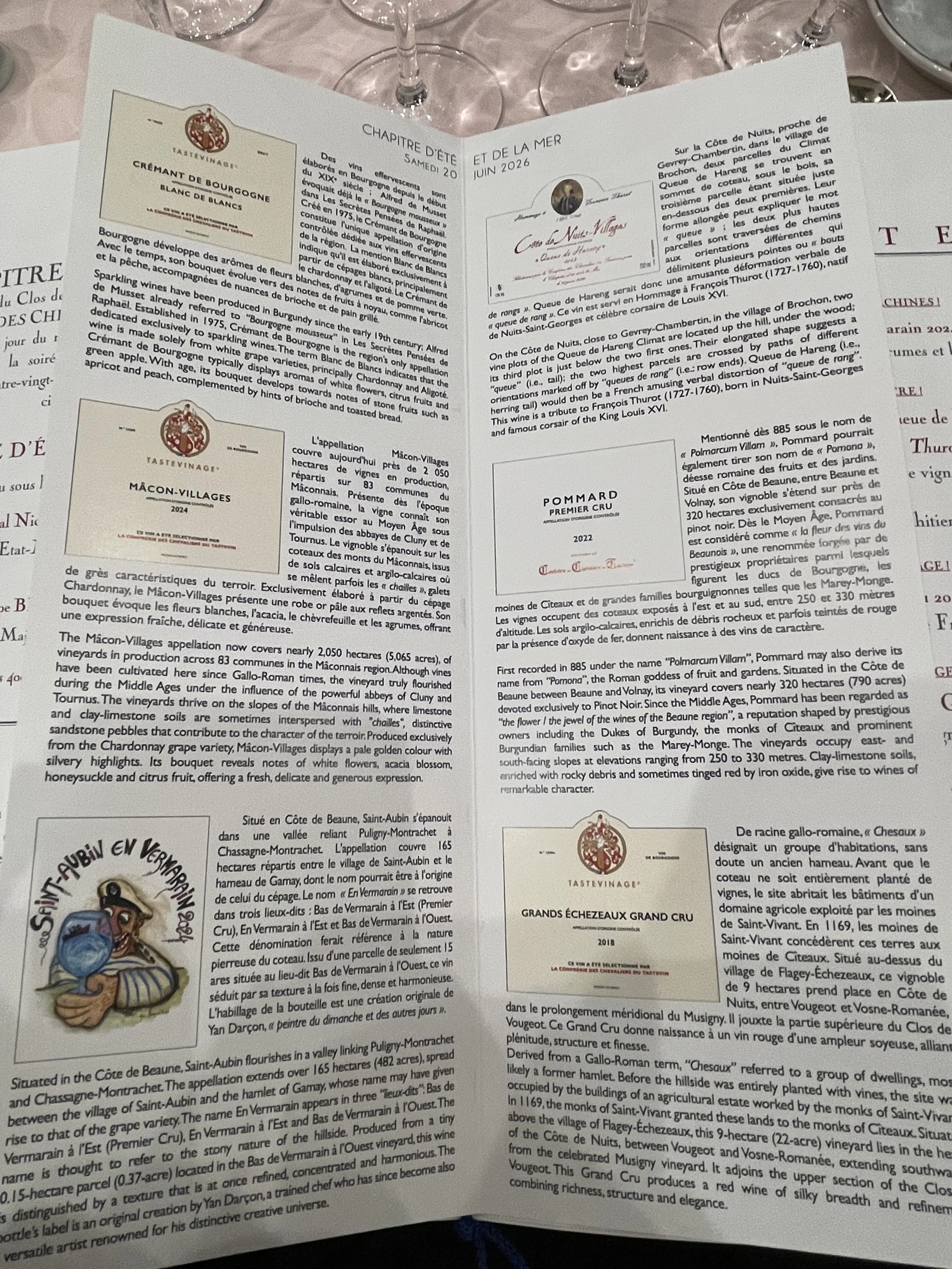
Clos Vougeot, France, 2026.
What's worth remembering, especially now, is that Burgundy's prices are a recent invention. Take Domaine de la Romanée-Conti. The 1990 vintage of Romanée-Conti, released in 1993, went out at the equivalent of roughly €150 a bottle. That same bottle trades today at up to €38,000. Even now, DRC's official release price sits around €4,600, well under the roughly €23,000 the wine commands on the secondary market, a gap the domaine maintains on purpose to keep bottles with people who'll actually open them rather than pure speculators. Through the 1970s and 80s this was expensive wine, but it was buyable, drinkable wine, not the trophy category it's become since.
None of that happened because the wine changed. It happened because a handful of growers built a story and a ritual worth traveling for, at a moment when the wine alone wasn't enough to get anyone's attention. Any region sitting on serious, underpriced wine today, and there are several, has the raw material Burgundy had in 1934. What most of them are missing is the nerve to build something around it.
Maybe that's the real takeaway about fine wine in general: the French have simply mastered the ceremony that surrounds it, more than most. Not just how to drink it, but how to pair it, since at a table like that, the wrong pairing won't just cost you a look from the sommelier. It'll get you quietly reassigned to the far end of the table with the Beaujolais drinkers, which, in that room, amounts to exile.
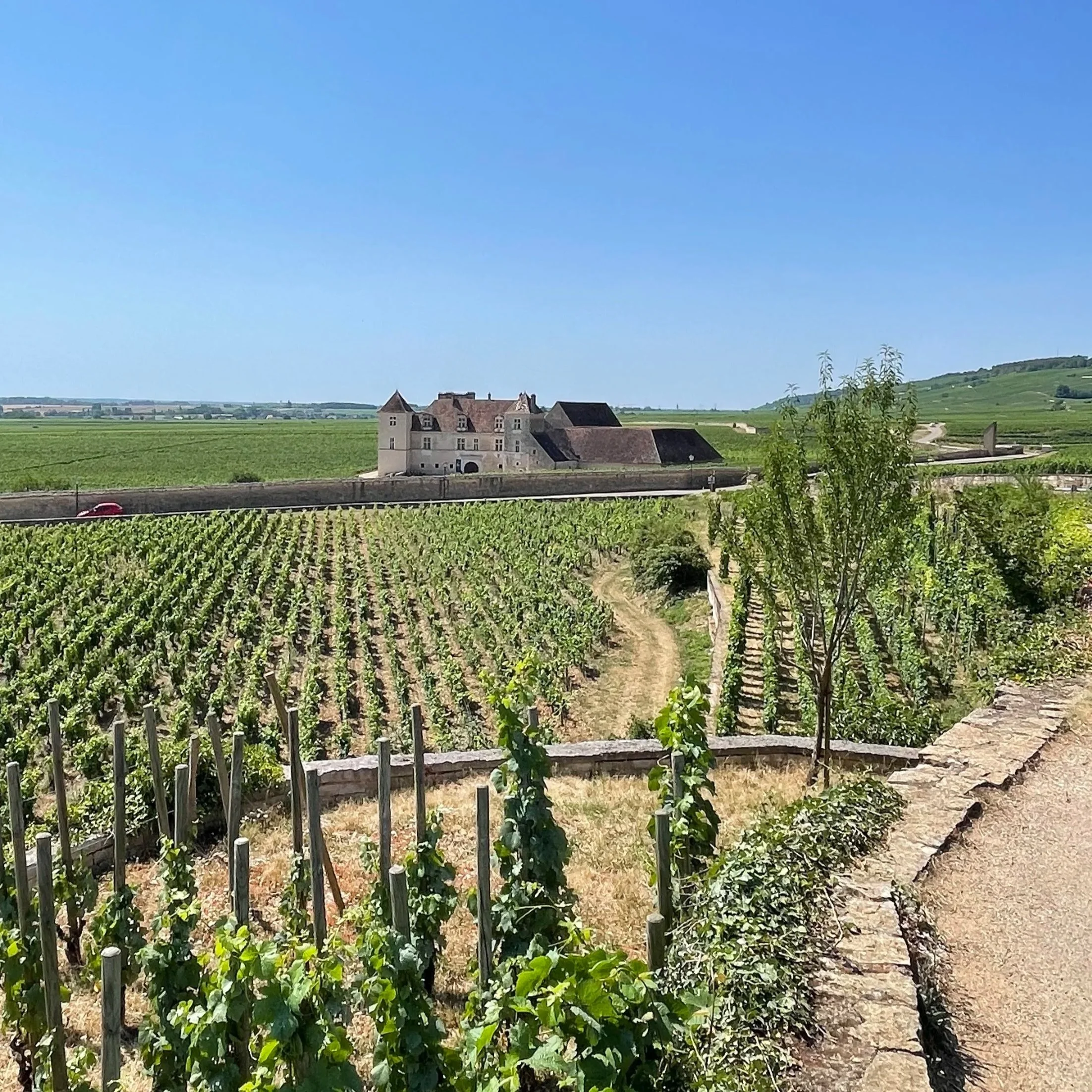
Clos Vougeot, France, 2026.