
Has fine wine really become more expensive over the last century? At first glance, the answer seems obvious. The world's most celebrated bottles now command prices that would have been unimaginable to previous generations. Château Lafite Rothschild, Romanée-Conti and other iconic labels have become luxury assets as much as wines, while collectors routinely pay thousands of euros for a single bottle. Yet comparing the value of fine wine across more than a century is surprisingly difficult. Inflation alone tells us very little, as currencies disappear, monetary systems change and purchasing power shifts over time.
A more meaningful benchmark is gold. Unlike paper currencies, gold has remained a remarkably stable store of value for centuries. By comparing the price of a bottle with the amount of gold it represented at the time, we can separate changes in purchasing power from changes in reputation. In other words, we can ask not whether fine wine has simply become more expensive, but whether it has become more valuable than one of history's most enduring measures of wealth.
Fortunately, one remarkable document allows us to answer that question. Printed in Vienna around 1900, this trilingual Wein- und Getränkekarte ("Wine and Drinks List") was issued by Österreichischer Lloyd, the Austro-Hungarian Empire's premier shipping company. More than a menu, it is a rare surviving example of Habsburg hospitality culture at sea. French, German and Italian appear side by side, reflecting the cosmopolitan nature of an empire whose ships connected Trieste with Alexandria, Constantinople, Smyrna, Naples and the wider Mediterranean. Alongside wines supplied by the Wiener Rathauskeller are some of Europe's most celebrated names: Château Lafite, Château Latour, Rauenthaler Auslese, Johannisberger, Veuve Clicquot, Louis Roederer, Madeira, Port and Marsala Florio. It captures a moment when the hierarchy of fine wine looked very different from the one we know today.
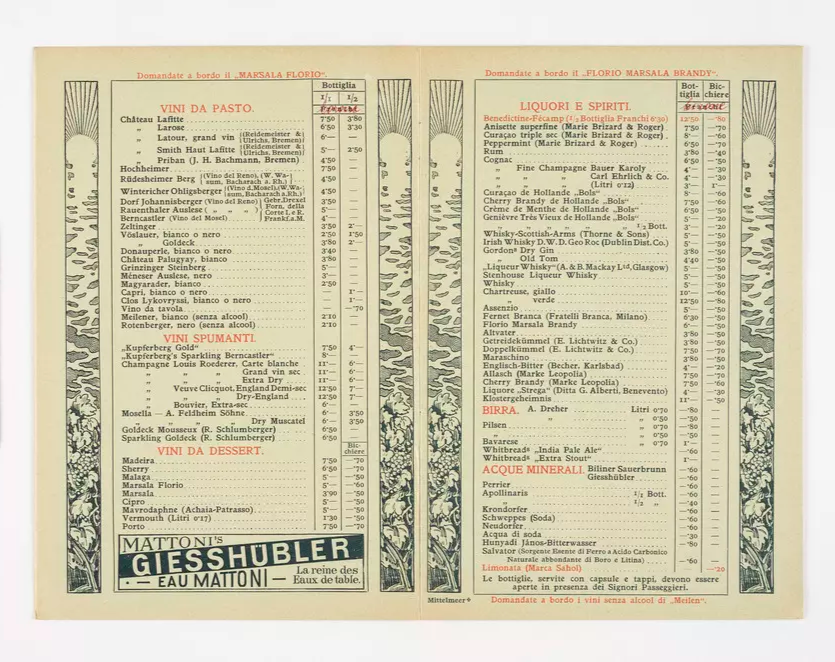
Wein- und Getränkekarte for ships of the Österreichischer Lloyd (Mediterranean Lines), printed by Christoph Reisser's Söhne, Vienna, c. 1900. Wien Museum, Vienna (Inv. No. 303239/1). Public domain (CC0 1.0). Available via the Wien Museum Collection: https://sammlung.wienmuseum.at/objekt/1079093. Prices below are transcribed from the menu's Kronen column.
Rather than attempting to convert Austro-Hungarian Kronen into modern euros; a calculation made almost meaningless by the collapse of the Empire and the monetary reforms that followed, we can compare each bottle with the quantity of gold it represented. Under the Austro-Hungarian gold standard adopted in 1892, one kilogram of fine gold was fixed at 3,280 Kronen, or roughly 0.305 grams of gold per Krone. Gold itself has preserved its purchasing power remarkably well over the past century, making it a far more reliable benchmark than inflation alone.
A bottle of Château Latour cost 6 Kronen, equivalent to approximately 1.83 grams of gold. At today's gold price, that represents roughly €210, yet a comparable bottle now retails for around €900. Château Lafite, priced at 7.5 Kronen, represented about 2.29 grams of gold, or roughly €260 today, while a bottle now typically sells for €900 to €1,000. In other words, Bordeaux's First Growths have appreciated to somewhere around three to four times their historical value when measured against gold rather than currency.
This increase has little to do with inflation. Instead, it reflects more than a century of reputation-building. The 1855 Classification, increasing scarcity, international auctions and growing demand from collectors transformed Bordeaux from one of Europe's great wine regions into the benchmark against which virtually every other fine wine is measured.
Yet not every wine followed the same path. Perhaps the most unexpected discovery on the menu is that Veuve Clicquot Extra Dry was actually more expensive than Château Lafite. At 12.5 Kronen, it represented almost 3.8 grams of gold, equivalent to roughly €435 today. A bottle of Veuve Clicquot Yellow Label can now be purchased for around €60. Far from becoming more expensive, one of the world's most recognisable Champagnes has become considerably more accessible in real terms, despite retaining its prestige.
The story of Marsala Florio is more dramatic still. Around 1900, a bottle cost 3.9 Kronen, corresponding to approximately 1.19 grams of gold, or about €135 at today's gold price. Today, an equivalent bottle can often be purchased for little more than €15 or €20. At the turn of the twentieth century, Marsala stood proudly beside Madeira and Port as one of Europe's respected fortified wines. Its decline says less about the quality of the wine than about changing tastes. Over the course of the twentieth century it gradually disappeared from the fine dining table and became associated more with the kitchen than the cellar.
German Riesling tells a quieter but no less telling story. Rauenthaler Auslese and Johannisberger appear alongside Bordeaux with no hint of hierarchy; a detail that is easy to skim past but hard to overstate. To the passengers of an imperial shipping line in 1900, the finest wines of the Rheingau were not a curiosity beside French claret; they were its equal. Germany continues to produce some of the world's greatest white wines, but their market value has remained much closer to their historical purchasing power. Their reputation among connoisseurs has endured, even as the wider market has increasingly rewarded Bordeaux instead.
The menu also reveals something that extends beyond prices. It preserves a drinking culture that has almost disappeared. Sweet and fortified wines occupied a far more important place than they do today. Madeira, Port, Malaga, Sherry and Marsala were considered indispensable to fine dining rather than occasional curiosities. German Rieslings, many produced in richer and sweeter styles than those fashionable today, ranked among Europe's most prestigious wines. Local Austrian wines appeared confidently beside the great names of France, reflecting a wine world that was simultaneously international and proudly regional.
The contrast with today's wine culture is striking. Europeans generally drink less wine than they did a century ago, but they drink with far greater attention to origin, producer and vintage. Dry wines dominate restaurant lists, while sweet and fortified wines have largely retreated to the margins. Champagne has become the universal drink of celebration, Bordeaux remains the benchmark for collectors, and Burgundy has emerged as perhaps the world's most coveted wine region. At the same time, there has been a renewed appreciation for historic wine regions and indigenous grape varieties, with Austrian wines and dry German Rieslings once again enjoying the recognition they deserve.
This modest wine list from the Österreichischer Lloyd reminds us that while gold preserves value with remarkable consistency, the prestige of wine is far less stable. Around 1900, German Rieslings stood beside Bordeaux, Champagne could command higher prices than Lafite, and Marsala belonged on the finest tables in Europe. More than a century later, the hierarchy has been almost completely rewritten; and there is no reason to assume today's the last word.