Bernard Huber
In light of my recent article about Pinot Noir from Neuchâtel, I would like to discuss an equally interesting wine region in southern Germany, Baden. While the region itself might deserve a full article, I believe one producer alone is worth a mention in the grail of amazing bottles. If you thought getting your hands on a bottle of Pinot Noir from Domaine des Landions was difficult, allow me to introduce you to the winery Bernhard Huber in Malterdingen.
It is a short drive from Basel, crossing German farmlands. Asparagus, plums, apples, plenty of food is grown in this area. Vines are part of a well diversified portfolio of crops, and climate change is undeniably helping. Quality has improved tremendously over the last decade, thanks to higher temperatures and longer summers. But before you take the drive, I should warn you. They have little to no wine to sell. Most of it goes through resellers or to lucky customers under strict allocation. They will nonetheless welcome you by appointment and show you some of their exquisite wines.
Like many high quality wineries in Germany, Bernhard Huber is part of the Association of German Prädikat Wine Estates, or VDP. A private association of more than 200 wineries setting standards for high quality dry wines. I would love to expand on this topic, but it deserves a proper article. What is worth mentioning here is that Bernhard Huber has maintained a serious, almost religious focus on soil and terroir, very much aligned with the VDP philosophy in general. The estate is also strongly influenced by the Burgundian way of classifying wines.
The wines from Bernhard Huber can be seen as a German interpretation of the Burgundian approach. If you allow a small pyramidal schema, the village wines sit at the bottom. This includes an excellent Blanc de Noir brut nature, interesting blends, and a disconcerting rosé that I particularly enjoyed. On the second level, you will find the Alte Reben, or old vines wines, made from Chardonnay or Pinot Noir. Finally, at the top, the Grosse Gewächse, produced from single plots of Chardonnay or Pinot Noir. This last category is the most sought after, nearly impossible to find, yet dangerously delicious.
The Grosse Gewächse are monuments in their own right, but I found myself especially drawn to the Alte Reben, a kind of Premier Cru if you allow the comparison. They are a perfect expression of the winery’s vision of freshness and perhaps less intellectual. To be fair, they are also easier to find, which adds to their appeal.
Earlier vintages were slightly more extracted and powerful, while modern wines are more delicate and fragrant. The acidic structure is what drives the Pinot Noir from Bernhard Huber. It brings joy and life that is not often found. The Chardonnays are equally impressive, with mouthwatering texture and saline notes. It is said that Bernhard Huber fell in love with a famous winery from the Côte de Beaune, Coche Dury, in the 1980s and wanted to replicate that style in the fatherland. I was lucky enough to taste a Meursault from Coche-Dury alongside a Chardonnay Alte Reben from Bernhard Huber, and I must acknowledge strong similarities in quality.
The style and the pyramidal classification of the wines are reminiscent of Burgundy, with its village, premier cru, and grand cru hierarchy. This is of course not accidental, but intentional, and I believe it makes sense. In a world where people have access to an unlimited amount of high quality wines, simplifying the selection process for customers is essential. The Burgundian approach is easy to understand.
The wines from Bernhard Huber are worth your attention. They are as rare as they are exquisite. They also demand patience. Consider cellaring them for a few years, some would say at least a decade. My personal advice: do not pair them with anything. Allow yourself to drink the bottle with a friend or a lover, and nothing more than the company of these monumental wines.
Bernhard Huber, Heimbacher Weg 19, 79364 Malterdingen, Germany.
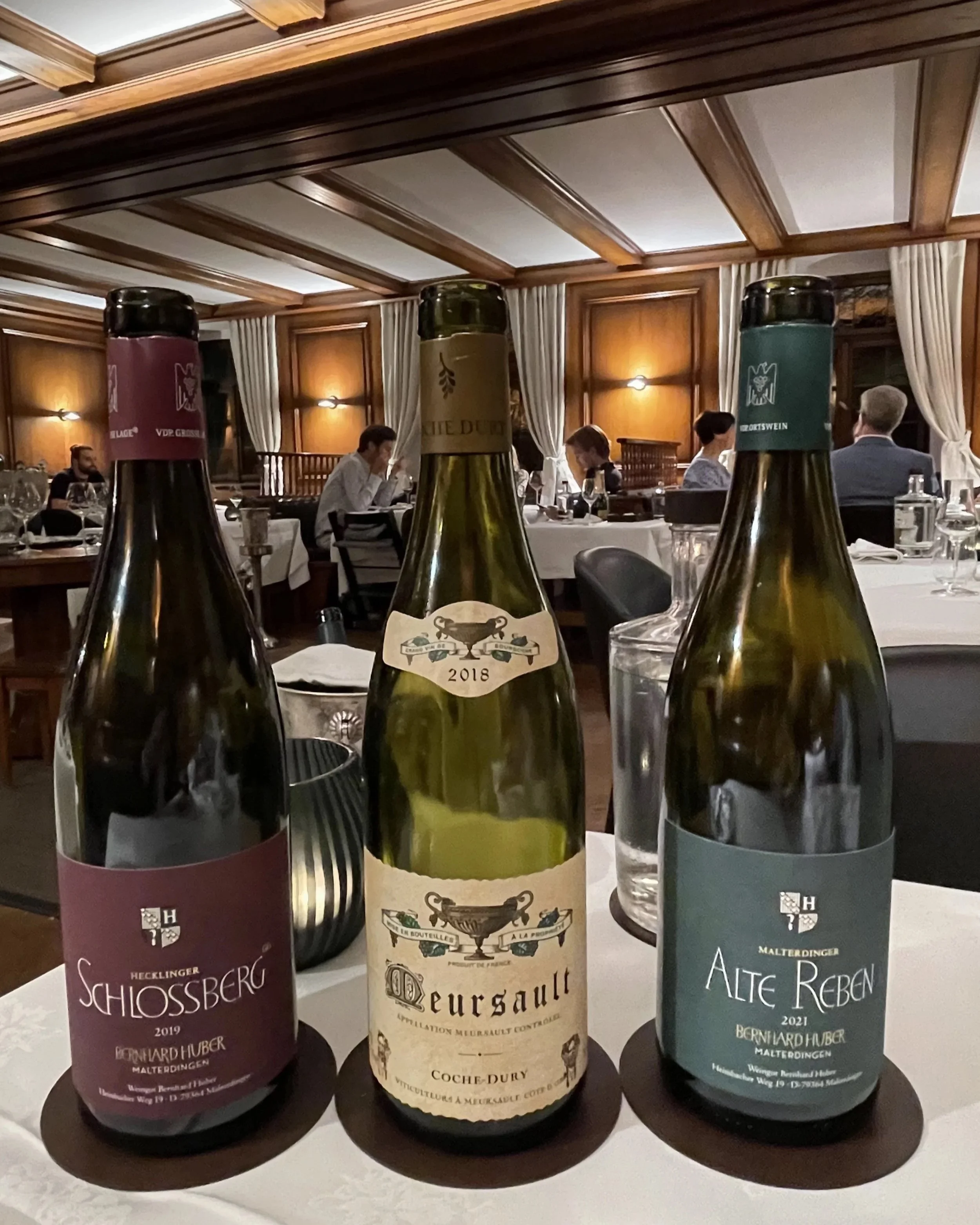
Schwarzer Adler, Vogtsburg im Kaiserstuhl, 2025.