Vienna is perhaps one of the most beautiful cities in the world, with its grandiose architecture, rich history and fantastic food. Yet, among the hills surrounding the Austrian capital, a treasure sits in plain sight: vineyards. Few visitors associate Vienna with wine, and fewer still realise that the city has a wine culture of its own, one that predates many of its grandest palaces. Vienna is not simply a city that happens to have a few vines. It is a fully fledged wine region, with 588 hectares under vine, approximately 175 winegrowing businesses and an annual production that reached 2.19 million litres in 2024. The vineyards extend from the outskirts towards the hills overlooking the city, at elevations ranging from 158 to 405 metres. They are not an ornamental curiosity maintained for tourists, but an integral part of the city’s economic and cultural life.
The history of Viennese wine stretches back to Roman times, if not earlier. The Romans cultivated vines around Vindobona, their military settlement on the Danube, and Emperor Probus is traditionally credited with encouraging viticulture in the region. The logic, as it is usually told, was straightforward: wine was part of a soldier’s ration, and transporting it from Italy was expensive. Better to grow it locally. By the Middle Ages, Viennese wine had acquired a reputation that extended well beyond the city. Not all vintages were quite so successful, however. Under Emperor Frederick III, the local wine was reportedly so acidic that it earned the nickname Fassbeisser, or barrel biter, supposedly sour enough to eat through the hoops of a cask. Rather than waste what was considered a gift from God, the wine was allegedly used in the mortar for St Stephen’s Cathedral. The cathedral still stands, which is more than can be said for the reputation of that particular vintage.
Among the most interesting traditions to survive from this long history is the Wiener Gemischter Satz. The name translates roughly as a Viennese mixed planting, although that hardly does justice to the idea. Unlike a conventional blend, in which different wines are combined after fermentation, a Gemischter Satz begins in the vineyard. Several grape varieties grow together in the same plot, are harvested together and are then fermented together. A single wine can therefore contain Grüner Veltliner, Riesling, Weissburgunder, Traminer and other varieties, each contributing something different to the final result.
The original logic was practical rather than romantic. Different varieties flower and ripen at different times, reducing the risk that bad weather would ruin an entire harvest. Some bring acidity, others body, fruit or aromatic complexity. The result is a wine that reflects not just a grape variety but the character of an entire vineyard. With the rise of varietal wines in the nineteenth and twentieth centuries, this tradition gradually lost ground, often being dismissed as a source of simple tavern wine. Its revival has been one of the more welcome developments in Austrian wine. Since the 2013 vintage, Wiener Gemischter Satz has enjoyed DAC status, with strict rules: the wine must be white, made from at least three varieties planted in the same Viennese vineyard and harvested and processed together. The largest variety may not account for more than half the blend, and the third largest must contribute at least 10 per cent. What was once a practical response to the uncertainties of farming has become one of Vienna’s most distinctive expressions of terroir.
Gemischter Satz deserves to be taken seriously. For generations it was poured to quench thirst in Vienna’s taverns, and much of it was never meant to be more. But the best examples show what a field blend can do: layered, textured wines in which each variety supplies what the others lack. Made with care, it is a wine of real character, and the growers who have pushed it onto the international stage have earned the attention it now receives. Yet Gemischter Satz is only part of the story. Vienna’s vineyards produce a surprisingly broad range of styles, from Grüner Veltliner and Riesling to Weissburgunder and Chardonnay, as well as some excellent red wines. The city is not defined by one grape or one tradition, but by the coexistence of several, shaped by different sites, soils and exposures.
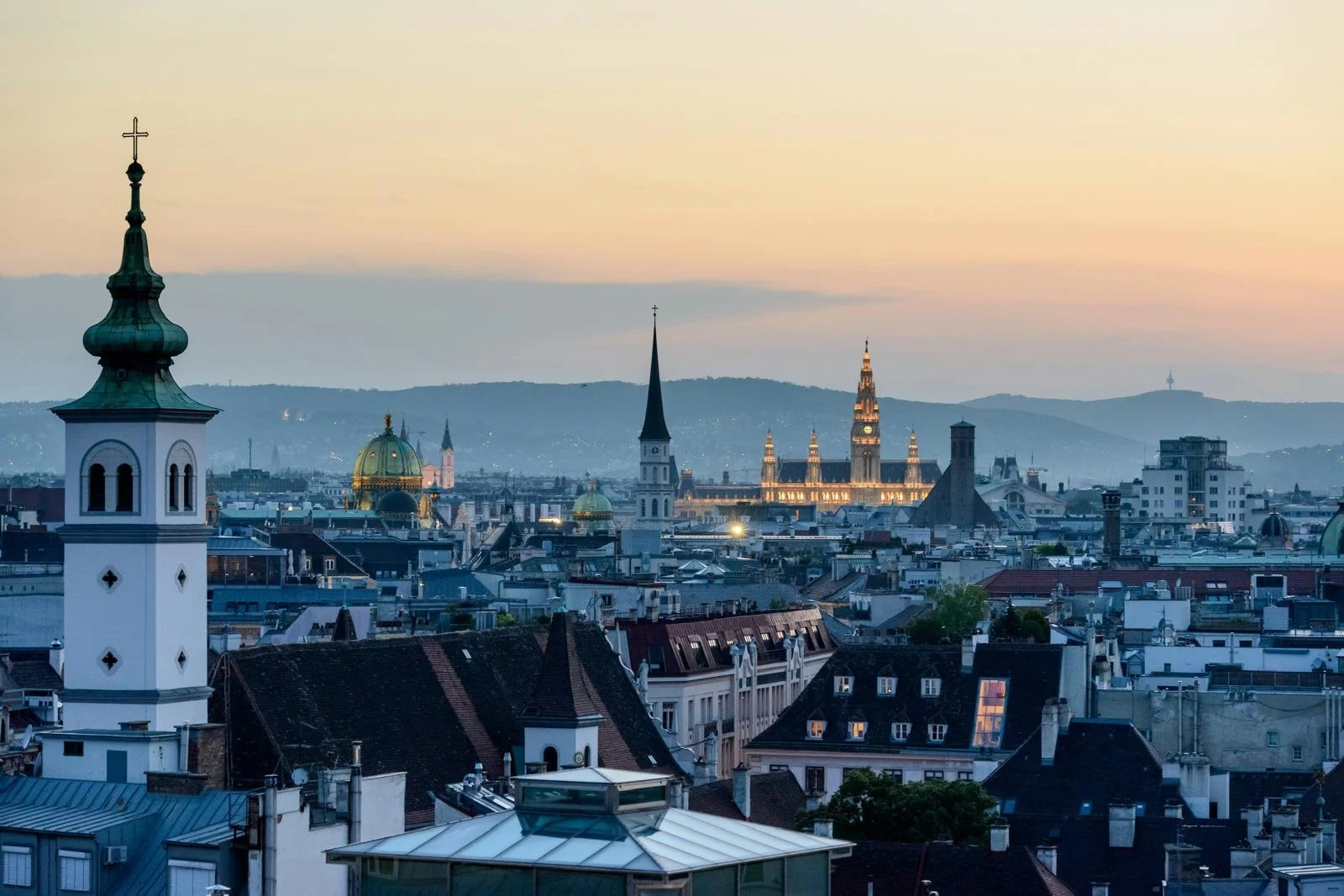
Vienna, 2024.
Two estates have played an important role in bringing Viennese wine back to serious attention. Mayer am Pfarrplatz has been producing wine in Heiligenstadt since 1683, making it one of the historic names of the region. Its most charming claim to fame, however, is a former resident. Ludwig van Beethoven lived in the house at Pfarrplatz in 1817, while working on his Ninth Symphony. Whether the wine inspired the composer is a question best left to the imagination, although the setting certainly lends itself to a romantic story. Today, the estate produces a broad range of wines, with Wiener Gemischter Satz at its heart, alongside Riesling, Grüner Veltliner and wines from individual vineyards such as Nussberg and Preussen. Its vineyards benefit from limestone-rich soils, the cooling influence of the Danube and the contrasting air currents coming from the Vienna Woods and the Pannonian plains.
Fritz Wieninger represents the modern face of the city’s wine revolution. Working across the Nussberg and Bisamberg hills, his family estate has helped establish that Viennese wine can compete well beyond the city’s traditional taverns. Wieninger farms its vineyards biodynamically and produces a diverse range of wines, from Gemischter Satz to Riesling, Grüner Veltliner and Pinot Noir. Its wines are exported to 45 countries, a considerable achievement for a producer whose vineyards lie within a major European capital. The differences between the limestone-rich Nussberg and the soils of Bisamberg offer a reminder that Vienna is not one uniform vineyard, but a collection of sites with distinct characters. Wieninger’s work has helped move Gemischter Satz from a humble local speciality to a wine that deserves attention in its own right.
Yet, to understand Viennese wine properly, one must eventually leave the tasting room and visit a Heuriger. The word refers both to the young wine of the current year and, by extension, to the traditional wine tavern where it is served. The custom was formalised under Emperor Joseph II in 1784, when winegrowers were granted permission to sell their own produce directly to the public. Traditionally, a pine branch displayed outside announced that the tavern was open. Inside, wine is served alongside cold meats, cheeses, spreads and other simple dishes, often at communal tables and sometimes accompanied by traditional Viennese music. These establishments are among the city’s most distinctive wine venues, cherished by locals and tourists alike. The atmosphere is less about analysing acidity than ordering another glass and staying longer than intended.
In a world increasingly obsessed with classifications, scores and the latest fashionable grape variety, Vienna offers something refreshingly different. Its vineyards are not an escape from the city but part of it, and its wines remain tied to the places where people actually drink them. Few wine regions can claim such a close relationship between urban life, viticulture and the traditions of the table. The Gemischter Satz embodies this spirit particularly well: several varieties, one vineyard, one harvest and one bottle. It is an argument for diversity over uniformity, and a reminder that wine need not be complicated to be interesting. In Vienna, some of the best things in life are still found hiding in plain sight.
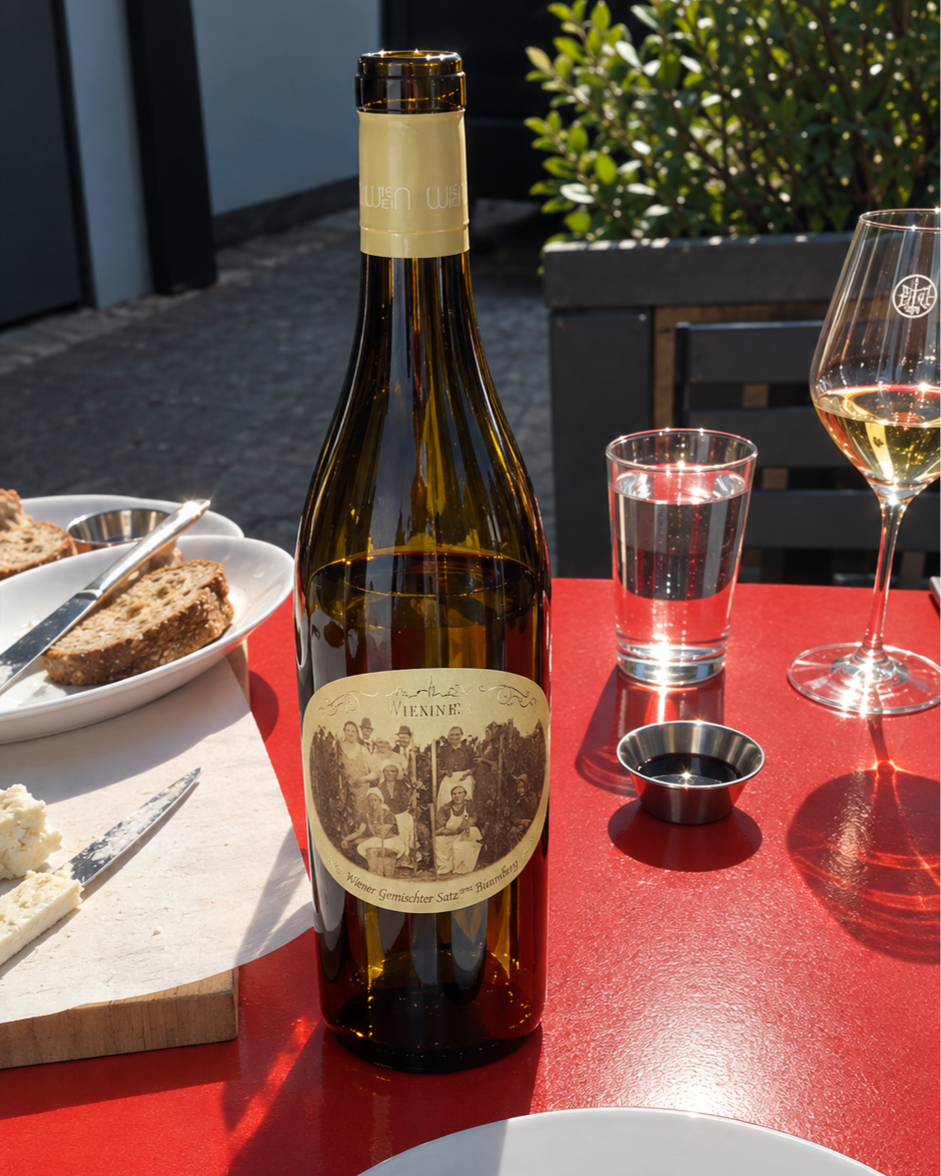
Vienna, Austria, 2024.