
Last week’s article focused on the rich and complicated history of Gorizia. Hopefully, you are by now convinced that the region produces some excellent wines. If you have not yet tried them, run to your nearest wine shop and get yourself a bottle of Ribolla Gialla or Merlot. Even better, plan a trip to Oslavia. Here are four winemakers who, each in their own way, have made this small corner of Italy one of the most interesting wine regions in Europe.
Gravner
Where else could we start? If Oslavia has become something of a pilgrimage destination for orange wine enthusiasts, Joško Gravner is undoubtedly one of the reasons why.
The Gravner family established its farm in Oslavia in 1901. Joško took over in 1973 and, rather ironically considering his reputation today, initially embraced modern winemaking. Stainless steel, temperature control and new technology were all part of his ambition to produce great wines. By the 1990s, however, he had become dissatisfied. After a hailstorm destroyed most of his 1996 crop, he experimented with extended skin contact on what remained. A journey to Georgia in 2000 proved decisive: there he discovered qvevri, large clay vessels buried underground and used for fermentation. Of the eleven he ordered, nine arrived broken. In 2001 he buried the survivors in his cellar, abandoning much of what had made him successful. It was no small gamble: when the new style was met with a hostile press, many of his foreign distributors cancelled their orders.
Gravner now cultivates about 15 hectares, split between Italy and Slovenia and planted almost entirely to Ribolla Gialla and Pignolo, producing roughly 20,000 to 30,000 bottles a year. The wines spend about a year in qvevri, followed by several years in large wooden barrels. They are made with patience and are not intended for immediate consumption. Merlot, for once, does not feature: his red, the Rosso Breg, is made from Pignolo.
In all fairness, I have never been allowed inside the estate. Perhaps one day I will finally be admitted into the temple of Gorizian orange wine. Until then, I shall have to content myself with drinking the wines, which is hardly the worst punishment.
Radikon
A few hills away, another family has played an equally important role in reviving traditional winemaking. The Radikons have farmed in Oslavia for generations, but it was Stanko Radikon who made the estate what it is today. He began experimenting with extended skin contact in 1995, gradually lengthening maceration and reducing sulphur. After his death in 2016, his son Saša carried on.
Radikon makes some of the most recognisable orange wines in the world, particularly Ribolla Gialla, Jakot and Oslavje. Yet perhaps the most interesting bottle from the estate is its Merlot. It follows a remarkably patient philosophy: at least five years in old wooden barrels, then many more in bottle before release. The result is structured, complex and built to age. If you visit Radikon, do not limit yourself to the orange wines.
La Castellada
La Castellada offers a particularly interesting story, especially for our Swiss readers. In 1954, Giuseppe Bensa returned to Oslavia after working as a carpenter in Switzerland. With his savings, he bought land and a house and opened a small tavern serving wine from the surrounding vineyards. In 1985, his sons Giorgio and Nicolò took the business further and began bottling under the name La Castellada. The third generation now carries it on.
The estate covers about ten hectares and produces around 25,000 bottles a year. Its whites, particularly the Ribolla Gialla, show how extended skin contact can give elegance without sacrificing freshness. But once again, the Merlot deserves particular attention: ripe fruit, acidity and a structure that develops beautifully with age. There is something satisfying about the idea that a carpenter returning from Switzerland helped found an estate making some of the finest Merlot in northeastern Italy.
Dario Prinčič
For wines made with minimal intervention, Dario Prinčič is another essential stop. His family grew grapes in Oslavia and sold them to local wineries, until Dario bottled his own wines in 1993. Behind the winery stands the Oslavia ossuary, a reminder of how heavily the First World War fell on these hills. Five years earlier, in 1988, he had stopped using synthetic chemicals in the vineyards. Like his neighbours, he embraced extended skin contact, spontaneous fermentation and limited sulphur, at a time when such practices were hardly fashionable.
Ribolla Gialla, Pinot Grigio and Trebež are among his best-known wines, but there is also, unsurprisingly by now, a Merlot. Released only after years of ageing, it offers a rather different reading of the Bordeaux variety, with mature fruit and earthy aromas. For anyone who believes low-intervention wines are necessarily unstable or excessively funky, a well-aged Prinčič Merlot makes a rather convincing counterargument.
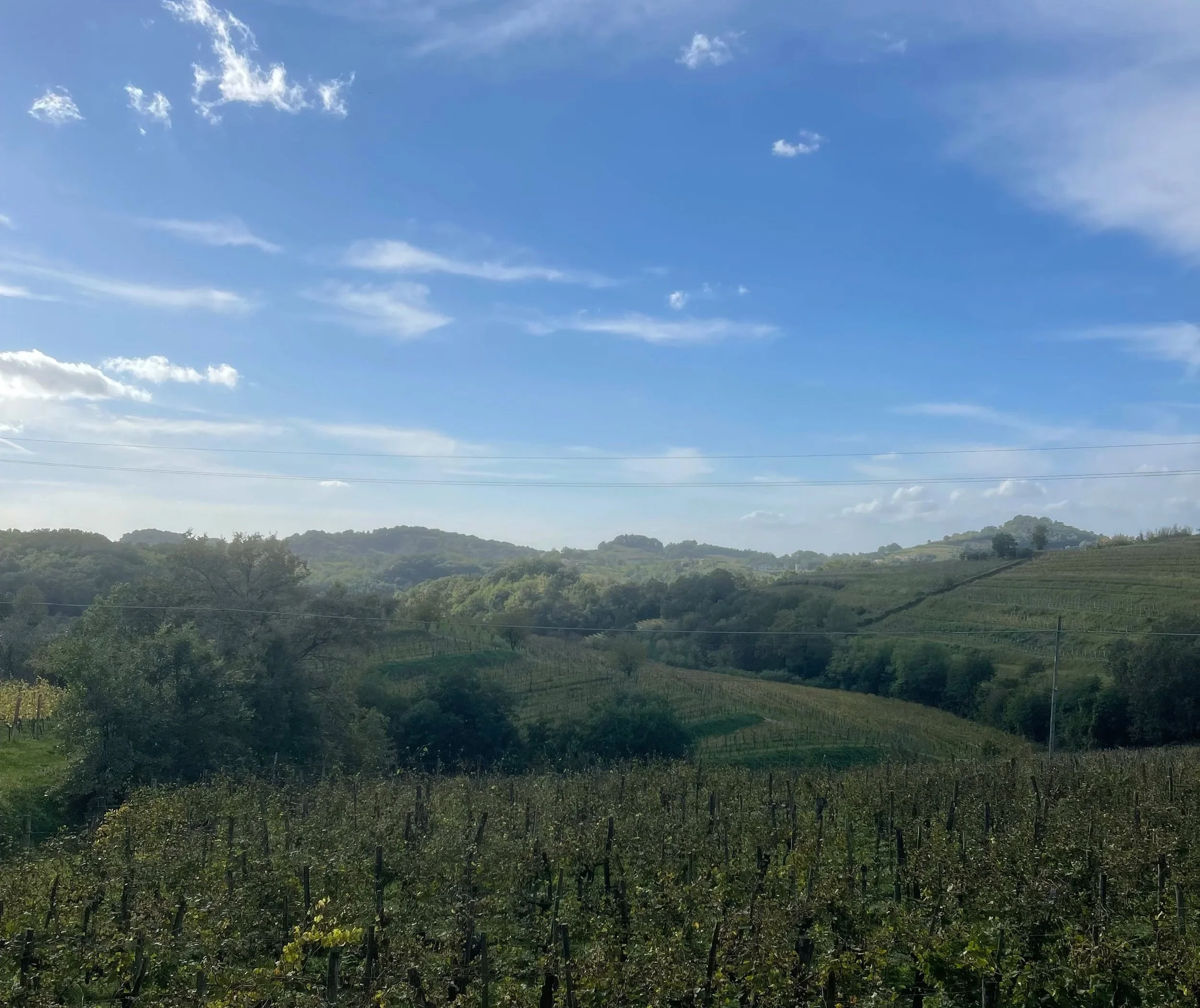
Oslavia, Italy, 2023.
Whether you appreciate orange wine or not, and whether Merlot features in your dreams or your nightmares, consider visiting Gorizia with an open mind. The winemakers of these hills have spent decades questioning conventional practice, often at real commercial risk, to make wines that last. Unlike many orange wines from fashionable bars that smell suspiciously like nail polish remover, or Merlot so overripe that one wonders whether it might be better spread on toast, the best wines of Oslavia show that tradition and minimal intervention need not come at the expense of elegance. They are not fashionable, and that is the point: the best of them will still be around when the fashion has gone. Mark my words.