
Following our earlier article on Brda in Slovenia, it is only fair to discuss its Italian neighbour. Relations between the two have not always been easy. Borders have moved, empires have collapsed and wars have been fought over these hills. Yet, peace was eventually found, perhaps around a glass of wine. And not just any wine, but orange wine.
Where exactly is Gorizia? In the northeastern corner of Italy, directly on the Slovenian border, lies a small city surrounded by some of the most interesting vineyards in the country. To the south is Trieste and the Adriatic Sea, to the north the Julian Alps, and to the east Slovenia. The surrounding hills, known as Collio in Italian and Brda in Slovenian, form a single geographical landscape, even if history has insisted on dividing it into two countries. The climate is particularly favourable to viticulture. The Adriatic brings warmth, while the mountains offer protection from cold northern winds. The result is a relatively mild climate with sufficient rainfall and a considerable difference between day and night temperatures, helping the grapes retain their acidity.
For centuries, Gorizia belonged to the Habsburg world. The city was part of the Austrian Empire and later Austria-Hungary, and its architecture, cuisine and wine culture still carry traces of that heritage. Trieste, just to the south, was one of the empire’s most important ports, connecting Central Europe to the Mediterranean. Wine from the surrounding hills travelled towards Vienna and the imperial court, rather than Rome. This corner of Italy has historically had much more in common with Ljubljana and Vienna than with Tuscany.
The First World War changed everything. Following Italy’s entry into the conflict in 1915, the hills surrounding Gorizia became one of Europe’s bloodiest battlefields. The Italian and Austro-Hungarian armies fought twelve battles along the Isonzo River, known today as the Soča in Slovenia. Hundreds of thousands of soldiers died or were wounded in a landscape that had previously been covered with vineyards and villages. Gorizia itself was captured by the Italians in 1916, only to become part of a much larger military disaster the following year, when the Austro-Hungarian and German armies broke through at Caporetto. The vineyards, unsurprisingly, suffered considerably.
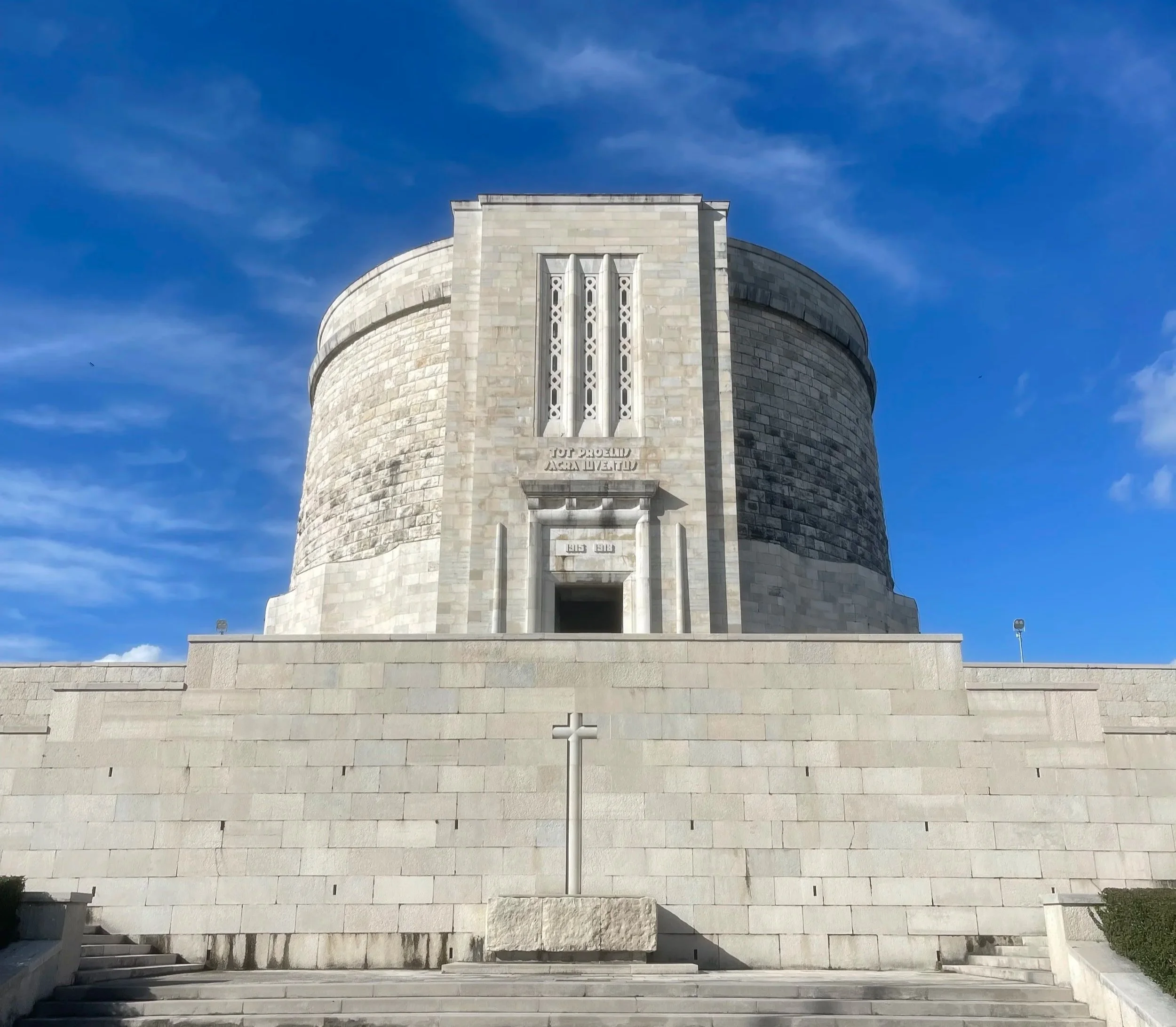
Cimitero dei Quattro Generali, Oslavia, Italy, 2023.
After the war, Gorizia became Italian, together with large territories inhabited by Slovenes. The interwar period was hardly peaceful. Under Mussolini, the Fascist regime pursued a policy of forced Italianisation, restricting the Slovenian language and suppressing local cultural institutions. The Second World War brought further destruction, occupation and political violence. When the conflict finally ended, the border was redrawn once again.
Gorizia remained in Italy, while much of its eastern territory became part of Yugoslavia. In 1947, the Yugoslav authorities began building Nova Gorica, literally New Gorizia, on the other side of the newly established border. Two cities, separated by a political frontier, emerged from what had once been a single urban and economic landscape. For decades, families, vineyards and communities lived on opposite sides of the Iron Curtain. Today, with Slovenia and Italy both members of the European Union and the Schengen Area, the border has become almost invisible. In 2025, Gorizia and Nova Gorica even shared the title of European Capital of Culture. History has a curious sense of humour.
But what about the wine?
The Collio Goriziano DOC covers approximately 1,300 hectares of vineyards, with production dominated by white varieties. Friulano, Ribolla Gialla, Sauvignon Blanc and Pinot Grigio are among the most important grapes. The region is particularly famous for its ponca soils, a mixture of marl and sandstone that provides excellent drainage and contributes to the character of its wines. On the Slovenian side, the same geological formation is known as opoka. Different names, same hills.
Perhaps the most fashionable wines from the region today are orange wines. Yet, what is often presented as a modern trend is, in fact, the revival of a much older tradition. For generations, winemakers in these hills produced white wines with extended skin contact, long before modern winemaking techniques made pale, crisp whites the international standard. By the late twentieth century, however, these practices had largely disappeared. It took a handful of rather stubborn winemakers to bring them back. During the 1990s, Josko Gravner and Stanko Radikon, both working near Oslavia, began questioning conventional winemaking and returning to older methods. Gravner eventually travelled to Georgia, where he discovered the ancient tradition of fermenting wine in buried clay vessels, known as qvevri. He introduced these vessels to his estate in the early 2000s, while Radikon continued developing his own approach. What began as a local rebellion against modern winemaking eventually became an international movement. Today, orange wines are produced around the world, but this small corner of Italy deserves much of the credit for their renaissance.
Oslavia itself is a small village within the Collio appellation that has become something of a spiritual home for the modern orange wine movement. It is also a place where the two halves of this story meet. On the same hills stands a large military ossuary, built to hold the remains of soldiers who fell in the Isonzo battles. The ground that once swallowed a generation of young men now gives some of the most distinctive wines in Europe. It is hard to look at those vines without thinking of what came before them.
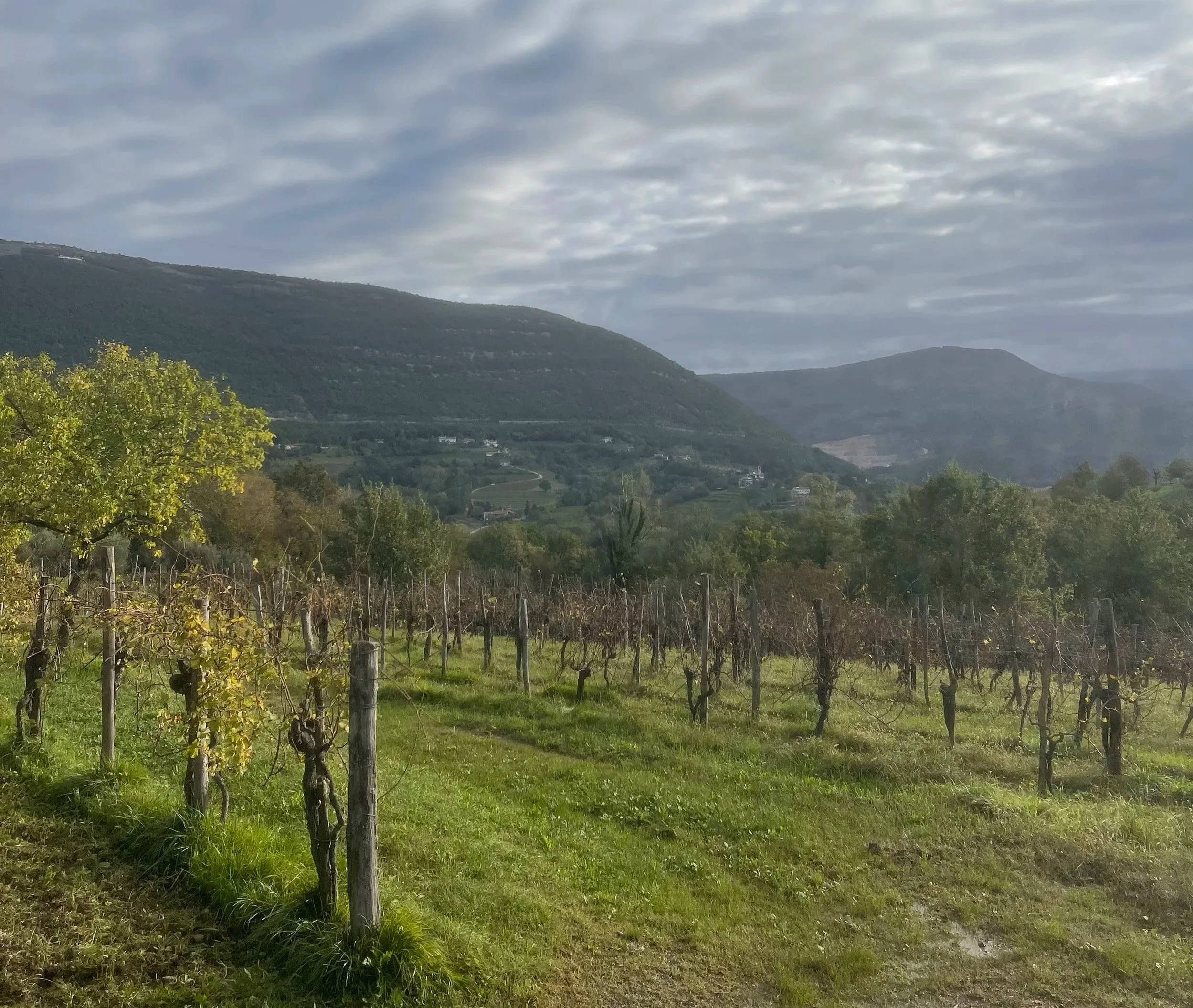
Looking into Slovenia, Oslavia, Italy, 2023.
Yet it would be a mistake to reduce Gorizia to orange wine. The region also produces excellent conventional whites, but perhaps the greatest surprise comes from a rather unexpected grape: Merlot.
Merlot has been cultivated in Friuli since the nineteenth century, introduced during the Habsburg period, and has found a remarkably suitable home in these hills. The combination of warm Adriatic influences and cooler air from the Julian Alps allows the grapes to reach full ripeness while retaining the acidity that gives these wines their freshness. The region’s ponca soils, with their excellent drainage and relatively limited fertility, help control vine vigour and contribute to wines with concentration and structure. The wines can be wonderfully elegant, with fresh acidity, restrained oak and beautiful aromas of red and dark fruit. These are no Pomerols in disguise, waiting to impress with concentration, extraction and expensive barrels. We are talking about a different interpretation of the Bordeaux variety, one that favours freshness, balance and drinkability over power.
Hopefully, you do not subscribe to the unfortunate adage made famous by Sideways: anything but Merlot. The grape deserves considerably more respect than a Hollywood film has allowed it. And if you still need convincing, allow yourself to be impressed by the quality of Merlot produced in the Gorizia Hills.
In next week’s article, we will visit a few producers who are crafting some truly excellent wines in this fascinating corner of Europe.