
What happened in 1976? Perhaps something relevant in the wine world? If you grew up in continental Europe, you may have no idea. If you come from the Anglo-Saxon world, 1976 means one thing: the Judgement of Paris.
On 24 May 1976, British wine merchant Steven Spurrier organised a blind tasting in Paris, pitting Californian wines against some of France’s finest: Chardonnay against white Burgundy, Cabernet Sauvignon-based wines against red Bordeaux. The nine judges were all French. The results were extraordinary. In the whites, the 1973 Chardonnay from Château Montelena came first. In the reds, the 1973 Cabernet Sauvignon from Stag’s Leap Wine Cellars beat Mouton Rothschild, Haut-Brion and Montrose (Time, 1976). California had beaten France with the very grapes that made Burgundy and Bordeaux famous.
The French were offended. France was the epicentre of fine wine, with centuries of reputation behind its estates. California was an outsider. Elsewhere in Europe, change was slower. Spain was emerging from dictatorship, and the Douro was still known for Port, not table wine. In Italy, Sassicaia had only just reached the market (first release in 1971, from the 1968 vintage), and the Super Tuscan movement was in its infancy. Against this backdrop, the tasting was more than an amusing event. It challenged the established order. It did not make French wines inferior, but it forced the industry to question its assumptions. If California could do this, it could keep improving.
The impact in the United States was significant. Before the 1970s, California’s industry was focused on volume, with varieties such as Carignane, French Colombard and Grenache covering far more vineyard area than Cabernet Sauvignon or Chardonnay (source to be added). From the 1980s, the shift towards premium varietals accelerated, and Napa Valley became its centre, attracting investment. The Judgement of Paris did not create this movement, but it gave California international recognition at a crucial moment.
American consumers followed. As quality rose, local producers became credible alternatives to imported bottles. Recognition attracted investment, investment improved vineyards and winemaking, and that strengthened the reputation further. France was slower to welcome the newcomer. California challenged a hierarchy that had stood for centuries. Peace came eventually, and its most symbolic expression was Opus One. In 1978, Baron Philippe de Rothschild of Mouton Rothschild partnered with Robert Mondavi to make a premium wine in Napa. The first vintage was 1979. It was more than a commercial venture: it acknowledged that the Old and New Worlds could learn from each other.
Napa is now a mature region with its own style. As a broad generalisation, it has a warmer, sunnier and drier growing season than Bordeaux. Morning fog from San Pablo Bay cools parts of the valley, and the surrounding mountains create varied exposures. Grapes usually reach full ripeness, giving ripe black fruit, generous texture and concentration.
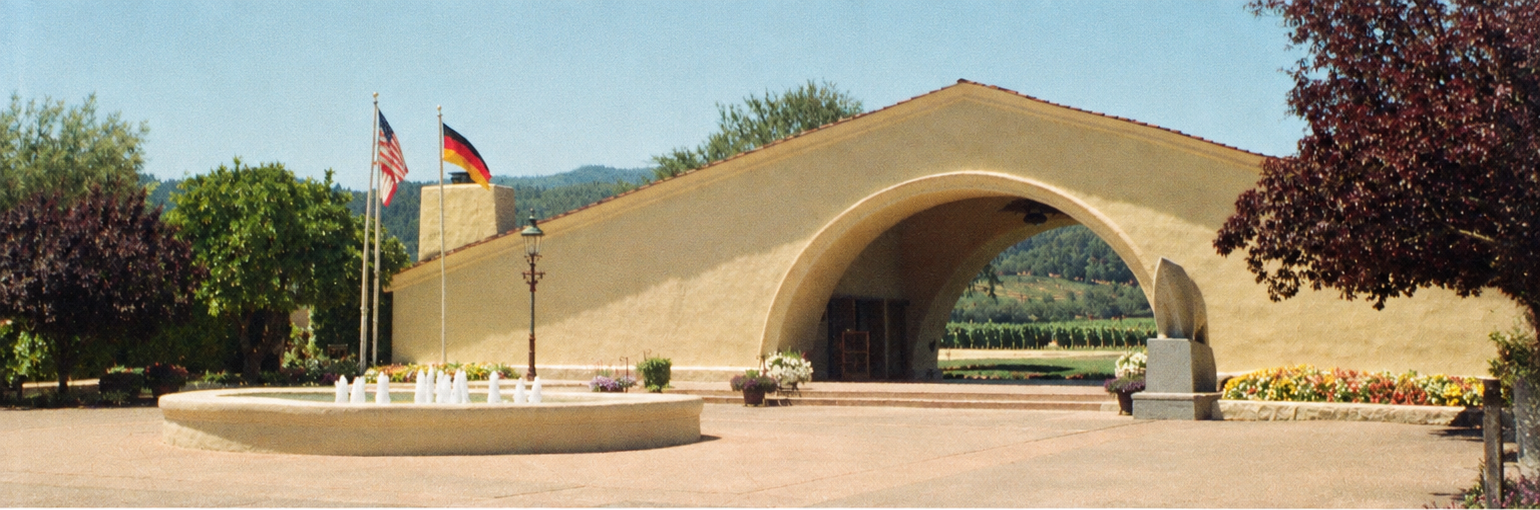
Robert Mondavi, Oakville, Napa Valley, 2012.
Bordeaux’s maritime climate brings more rainfall variability and a higher risk of difficult harvests. Its wines tend to show firmer acidity, more restrained fruit and savoury notes of cedar, tobacco and graphite. Napa Cabernet more often offers cassis, blackberry and dark chocolate, with fuller body. These are tendencies only; producer, vineyard and vintage matter as much as region.
At a recent Gallo tasting in Zurich organised by the Zürich Wine Academy, I tried Lot No. 1 from Louis M. Martini 2018. Founded in 1933 by Italian immigrant Louis M. Martini, it is one of Napa’s historic wineries, and its focus on Cabernet Sauvignon helped lay the foundations of the valley’s premium industry after Prohibition.
Lot No. 1 is the estate’s most ambitious Cabernet. The variety is clear on the nose, with dark fruit and cassis, but in the glass this is unmistakably Napa: bright, full bodied, elegant. There is plenty of ripe fruit and generosity, with enough balance to avoid heaviness. That is what makes it interesting. It does not imitate Bordeaux or hide its origins. It embraces what made Napa successful: ripe fruit, concentration and the pleasure of a generous, well-made wine.
It is easy to dismiss Napa as a pale imitation of Bordeaux. The red grapes are largely the same, and many producers openly drew on France. But fifty years have let Californian winemakers develop their vineyards, refine their techniques and build a distinctive style. Perhaps that is the legacy of the Judgement of Paris. It was not simply California beating France. It showed that great wine belongs to no single country, and that even the oldest traditions can be challenged. Bordeaux remains Bordeaux, and Napa has become Napa. Each has its own expression of Cabernet Sauvignon and its own place in fine wine. That is a better outcome than a contest between Old and New World.

Darioush Winery, Napa Valley, 2012.