
Tokaj: An Introduction
Every wine drinker, be it the most renowned taster or the casual sipper, has a cherished wine. A wine that sends goosebumps down the spine, draws a smile on a sad face, and makes the heart beat at unheard-of speeds. For me, that wine is Tokaji Aszú. A wine so beautiful it seems to exist outside of time.
And outside of time it truly is. While wine consumption has declined over the years, sweet wines have suffered the most. Sugar and alcohol, perceived as enemies of the modern world, yet when united, they can achieve something profoundly harmonious. Across the globe, from South Africa to France, from Sicily to Crimea, great sweet wines have been made. And yet, nothing quite matches the mesmerising Aszú wines of Tokaj.
It is said that noble rot (Botrytis cinerea) was first harnessed here in the 16th century, and in 1737, Tokaj became the first officially classified wine region in the world. Known as the wine of kings, Tokaj flourished in the 18th and 19th centuries, its bottles gracing royal courts across Europe. The 19th and 20th centuries, however, brought a succession of misfortunes: phylloxera, wars, shifting borders, pogroms, all of which dramatically affected both production and the region’s economy.
Then came collectivisation under the communist regime, and with it, the near death of delicate wines. Quotas were imposed, quality gave way to quantity, and vineyards were planted on flat, easily mechanised land to maximise yields. The hills, Tokaj’s true jewels, were largely abandoned. Alcohol could be added, wines diluted, and efficiency reigned supreme. The apparatchik had to be fed, and his thirst satisfied. A vin muté in Tokaj? An unthinkable idea made reality.
With the fall of the Iron Curtain, Eastern Europe reopened to the world, and Tokaj began its awakening. Wineries re-emerged, often with the support of foreign investors. For all the damage inflicted by collectivisation, exhausted soils, heavy pesticide use, it had one unintended benefit: the steep hillsides were left largely untouched for decades. Too difficult to exploit, they remained dormant, sometimes tended only by families for personal consumption. After nearly fifty years, these vineyards were in remarkable condition, ready once again to produce great wines.
Tokaj is a region of small volcanic hills, bordered by the Bodrog and Tisza rivers. Their confluence plays a crucial role in the region’s identity, generating soft morning mists during autumn. These mists encourage the development of noble rot, while sunny, breezy afternoons allow the grapes to slowly dehydrate rather than spoil. This delicate alternation between humidity and dryness lies at the heart of Tokaj’s greatness.
The complexity of Tokaj also lies in its multi-layered classification system. Like Barolo or Burgundy, Tokaj has a historic vineyard classification. Around 500 classified crus (dűlő) define the region, among them famous names such as Király, Szent Tamás, Bétsék, and Hétszőlő. Beyond terroir, Tokaj is also defined by its extraordinary diversity of wine styles, each requiring a distinct and often demanding method of production. while Aszú is the most famous, it seems important to distinguish the style of Tokaj:
Late Harvest
Made from overripe grapes, sometimes lightly affected by botrytis, these wines are accessible and aromatic, offering sweetness balanced by Tokaj’s naturally high acidity. They are often fruit-forward and approachable in youth.
Szamorodni
Meaning “as it comes,” Szamorodni is made from whole bunches containing both healthy and botrytised grapes. It exists in both sweet and dry styles, the latter being one of Tokaj’s great hidden treasures—nutty, oxidative, complex, and profoundly gastronomic.
Tokaji Aszú
The region’s crown jewel, the heart of Tokaj. Berries are picked individually by hand, shriveled and covered in noble rot. A paste is created with the harvested berries, then mixed with a must, usually from the same vineyard. The mixture macerates for several days, is pressed, and transferred to barrels for aging.
The Puttonyos System
Puttonyos refers loosely to the basket used to harvest the botrytised berries. Commercially, it was used to define the sugar level of a Tokaji Aszú. The more puttonyos written on the label (3, 4, 5 or 6), the sweeter and more concentrated the wine. Recently, this terminology has been gradually replaced by minimum sugar requirements, shifting the focus from sugar level to vineyard and terroir expression—a welcome evolution in tune with modern tastes.
Tokaji Eszencia
Not quite wine, but nectar. Made solely from the free-run juice of botrytised berries, Eszencia ferments naturally to very low alcohol and extreme sweetness. The must is not pressed but allowed to flow drop by drop.
Dry Tokaj
A modern renaissance has brought increasing attention to dry white wines. Some say this is the future of Tokaj. Perhaps, but Aszú will always remain, for me, its beating heart.
Wines are mostly made from Furmint, Hárslevelű, Yellow Muscat, and other minor varieties such as Zéta or Kabar. On a recent trip to Tokaj, I spoke with several winemakers about the grapes that should lead the region’s future. Opinions varied widely: some promoted Furmint as Hungary’s flagship grape, others stressed terroir over variety, while a few advocated Yellow Muscat for its resilience in a changing climate. These discussions illustrate the pluralism of modern Tokaj: after decades of collectivisation, winemakers now flourish in individuality. No two Aszú wines are alike; one producer may emphasise acidity, another digestibility.
One last note: you may wonder about the sugar level of the different styles. I abhor these discussions. Sugar content alone is meaningless if not considered alongside acidity, structure, and balance. Two Tokajis with the same sugar content can feel completely different. I encourage readers to forget the numbers and contemplate their glass of Aszú, asking instead: would Catherine the Great have cared about sugar content, or would she have reached for a second bottle?
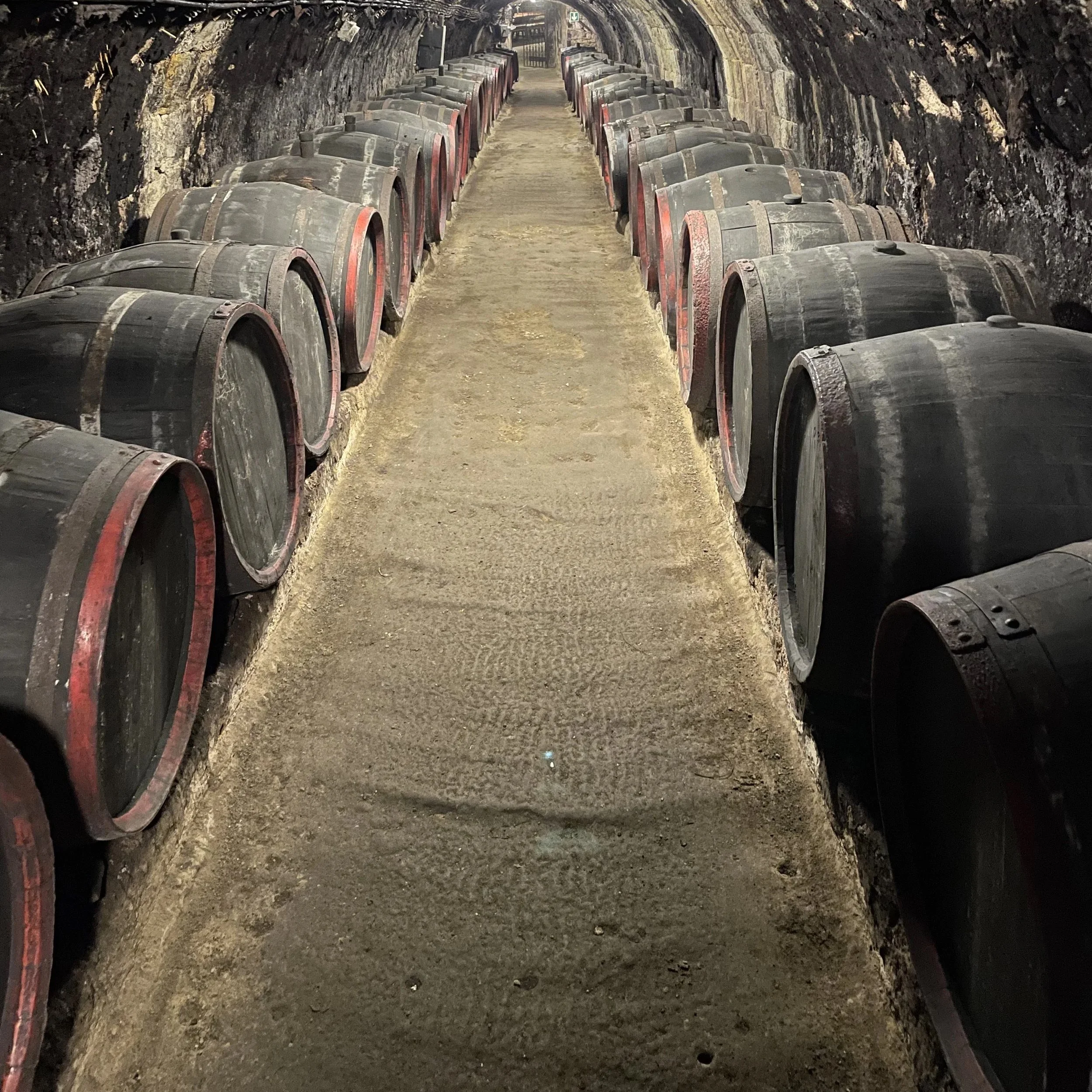
Hetszölö cellar, Tokay, 2022.